
What the day feels like
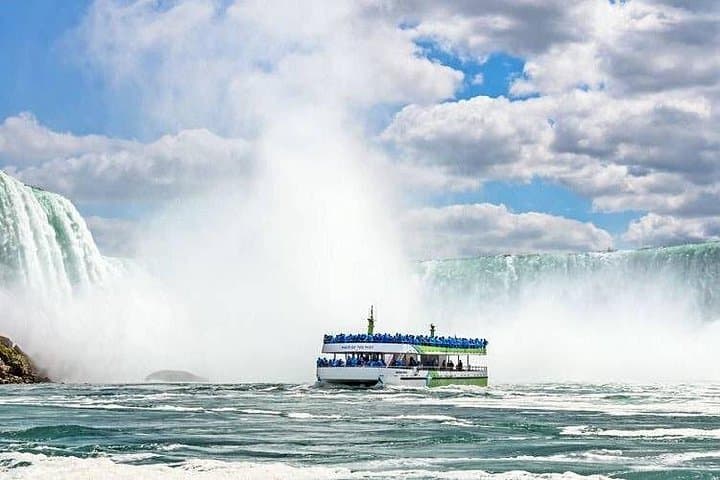
The first thing that grabs you is the sound—an omnipresent, rolling percussion that arrives before the falls do. You round a corner on Goat Island and the world compresses to water: white sheets of spray, the thunder of millions of gallons unspooling over stone, a mist that smells faintly of iron and river mud. The Maid of the Mist boat appears like a small determined moth in the gray-green chaos, engines humming, passengers leaning into the spray. For five hours you will live in the in-between space of Niagara Falls—the boardwalks, the wooden decks at Cave of the Winds, the observation platforms where gravity announces itself in the form of falling water.
This is not a long wilderness trek; it’s an intense, elemental encounter. The full itinerary—Maid of the Mist, Cave of the Winds, Niagara Observation Deck, and a circuit of Goat Island—moves you from river to gorge to right up against Bridal Veil Falls. Distances are short: expect roughly 1–2 miles of walking on paved paths and boardwalks on Goat Island, a climb and descent of about 150–200 wooden steps at Cave of the Winds, and the 20–25 minute roundtrip of the Maid of the Mist. Elevation gain is minimal overall, but the stairs and wet surfaces add a deceptively muscular element: you’ll work your legs and your balance.
Geologically, Niagara is young and furious—carved at the end of the last glaciation roughly 12,000 years ago as Lake Erie found an outlet to Lake Ontario. The underlying dolostone and shale make for a layered cliff face that erodes in dramatic stages, a process you can almost watch if you stand long enough on the observation deck. Culturally the river has been a border and a conduit: a seasonal highway for Indigenous peoples, a colonial frontier, a 19th‑century spectacle that fueled early tourism, and later, a locus of hydroelectric power debates. The U.S. side—Niagara Falls State Park, the nation’s oldest state park—keeps much of that history visible in small ways: stone bridges, promenades, and plaques that call attention to the river’s ecological and human stories.
Why bother with the American side when the Horseshoe Falls is a Canadian panorama? Because this route puts you inside the meeting of river and drop. The Cave of the Winds walk takes you to Hurricane Deck, a series of wooden platforms that let the Bridal Veil Falls literally run through you—water dares you to stay dry. The Maid of the Mist boat keeps you close enough to taste the spray and feel the wind push at your rain gear. Goat Island offers quieter perspective: tree pockets and river eddies that show the Falls aren’t only spectacle but system.
Practicalities are straightforward but matter. This is a wet, loud day—waterproof layers, a secure phone case, and grippy shoes aren’t optional. The entire experience moves at a comfortable pace for most hikers: expect to be on your feet for roughly 3–5 hours depending on crowds and photo breaks; the Viator experience runs about 300 minutes, which includes transit time for tours operating from nearby cities. Peak summer months fill the decks and boats; early mornings and late afternoons offer fewer people and softer light for photography.
Safety pivots on two things: footing and documentation. Many of the wooden walkways and stone steps can be slippery; use the handrails and take your time on the stairs at Cave of the Winds. If you’re traveling from outside the United States—especially from Toronto on one of the day tours—carry a passport and check U.S. entry requirements ahead of time. Tickets for Maid of the Mist and Cave of the Winds are timed and can sell out on holiday weekends; booking in advance is a practical must.
For families and first-time visitors, the visceral immediacy is the attraction—the kind of natural spectacle that sticks in memory. For repeat visitors and photographers, the trick is to find the small angles: the curl of foam in a river eddy, the way a sunbeam can momentarily turn spray into a curtain of light, or the cold green pool where the river calms above the brink. Environmentally minded travelers should be aware that the Falls are both a protected park and a working watershed; stay on marked paths, respect wildlife, and follow Leave No Trace basics.
What to expect: a short, active day that is heavy on sensory payoff. Plan for quick-dry clothing, a waterproof outer layer, secure shoes, and a well-charged camera. Bring cash or card for locker rentals and food kiosks; there are cafés and picnic spots near the park entrance, but dining options fill up fast in high season.
In the end, Niagara on the U.S. side is less about conquering a mountain than about submitting to a force. The river pushes, the falls demand attention, and you come away with a clearer sense of scale and a pocketful of wet photographs. It’s an ideal day for people who want drama without a long approach—a place where geology and engineering, history and tourism, all collide under a permanent roar.
Trail wisdom
Small choices, better day.
Embrace the wet
Bring a waterproof shell and use park-issued rain ponchos to keep electronics dry; gear straps are useful for phones and cameras.
Grip matters
Wear shoes with sticky soles—wooden decks and stone steps become slick under constant spray.
Timing reduces crowds
Visit early morning or late afternoon to avoid peak tour groups and get softer light for photos.
Pack light for the boat
On Maid of the Mist keep loose items zipped or stowed—spray can catch small items and carry them off.
Local knowledge
Read the place, not just the route.
Watch for native species including Gulls and terns skimming the spray, River fish such as trout and bass in calmer upstream pools.
Keep an eye out for wildlife during the transition between areas and habitats. Respect distance guidelines.
The park balances tourism and protection—stay on marked paths, avoid feeding wildlife, and use refillable water bottles to reduce plastic waste.
Follow the guide's instructions on size limits, ethical handling, and leave-no-trace practices.
The quieter upstream banks of Goat Island where the river calms into eddies. Short footpaths to lesser-used viewpoints near Terrapin Point (check for access restrictions)
Locally recommended viewpoints and quiet spots known best to local operators.
Niagara Falls State Park, established in 1885, is America’s oldest state park and was designed to preserve the natural spectacle from industrial encroachment.
Maritime roots and regional tradition shape the waterways and working coasts.
Seasonal guide
Four versions of the same landscape.
Spring
Best forWaterfall volume is high · Fewer crowds than summer
ChallengesCool temperatures · Variable weather
Spring brings strong flows and dramatic mist; expect chilly air and muddy approaches after thaw.
Summer
Best forWarm weather · Full visitor services · Extended daylight for photos
ChallengesLargest crowds · Higher prices and sold-out time slots
Summer is peak season for Maid of the Mist and Cave of the Winds—book ahead and arrive early.
Fall
Best forCrisp air and fall color · Fewer tourists than summer
ChallengesShorter daylight · Cooler water spray makes conditions brisk
Autumn offers cooler, clearer light and attractive foliage on Goat Island—layers are recommended.
Winter
Best forIce formations and dramatic low-light scenes · Very few crowds
ChallengesMany attractions close or operate limited hours · Icy walkways
Winter transforms the gorge into an icy spectacle; check attraction hours and prepare for icy conditions.
Pack with intention
What to bring.
Good to know
Common questions.
The boat experience itself lasts about 20–25 minutes roundtrip, though boarding and disembarkation add time—plan for 45–60 minutes total.
Plan the edges
The details that make the day easier.
Niagara Falls was formed at the end of the last Ice Age—roughly 12,000 years ago—when meltwater carved a channel between two lakes, creating the falls we see today.
After you’ve walked the decks and felt the spray, seek out regional flavor: try classic Buffalo-style wings across the river in nearby Buffalo or grab a locally brewed beer at a Niagara Falls taproom—look for eateries that highlight regional beer and seasonal produce.
- Closest airport
- Buffalo Niagara International Airport (BUF), ~25–30 minutes by car; Trailhead: Niagara Falls State Park
- Goat Island entrance; Driving distance from Niagara Falls, NY downtown
- under 10 minutes; Cell service: generally good but can be patchy in the gorge; Permits
- passes
- tickets required for Maid of the Mist and Cave of the Winds, book in advance.
This is a sensitive watershed and protected park—stay on boardwalks, pack out trash, and avoid using single-use plastics near the river to protect aquatic and shoreline habitats.
Explore by topic
Follow the threads.
Keep exploring
Make the story part of the trip.
 Related story
Less than two hours from Nairobi, Kereita Forest pairs hands-on canopy adventure with quiet montane trails and a sobering colonial history—perfect for families, teams, and curious travelers seeking a full-day pulse of nature.
Set out from Bass Harbor for a private, customizable day on Blue Hill Bay — lighthouses, puffins, seals, and the chance to feel Acadia from the water. Small groups, local captains, unforgettable views.
In four hours you can move from shaded canyon ferns to wind-scoured coastal ridgelines, guided by someone who knows where the light—and the hidden views—live. This private half-day hike on the Monterey Peninsula or Big Sur is compact, curated, and perfect for travelers who want depth without a multiday commitment.