
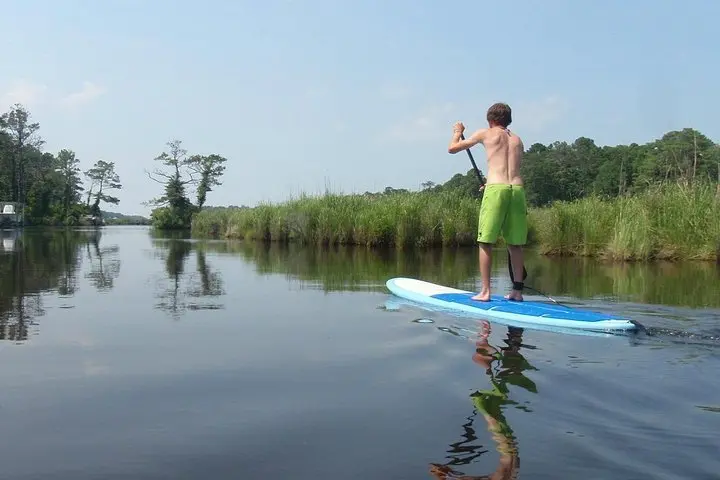
What the day feels like
You ease a paddle blade into water the color of pewter and watch the ripples march away in tidy concentric rings. The marsh breathes around you—cordgrass whispering, a lone osprey scouting the edges, and a warm wind that carries salt and pine from the maritime forest. Here, on the sheltered bays off Kitty Hawk, the ocean’s heave gives way to gentle currents; the water dares you forward more as an invitation than a test. For an hour and a half, the world narrows to the glide of your board, the sound of call-and-response birds, and the quiet geometry of tidal channels.
This is the essence of the Stand Up Paddleboard Adventure on the Outer Banks: a short, accessible trip that feels like immersion rather than instruction. Launching from 6150 North Croatan Highway, the tour slips into the North Carolina Coastal Reserve, one of the Outer Banks’ most intact maritime forest and salt-marsh ecosystems. The route winds between Martin’s Point and Southern Shores, and it’s built for first-timers and intermediate paddlers alike—calm water, steady guidance, and a landscape that rewards low, slow perspectives.
Geologically, the Outer Banks are a living shoreline—long, narrow barrier islands formed by shifting sand, wind, and waves. The salt marshes between mainland and barrier islands are sediment sinks and nurseries: fiddler crabs, shrimp, and juvenile fish move through the channels, while the grasses hold the bank together like long, interwoven fingers. Culturally, these waters were highways for maritime communities—fishermen, shrimpers, and oystermen—who read tides and winds as closely as a pilot reads instruments. Today, small local operations keep that knowledge alive and share it with visitors looking to experience the landscape without bulldozers or big boats.
Wildlife here has a casual confidence. Look for great blue herons standing like sentinels on exposed mudflats, and royal terns skimming the surface. In warmer months you might spy diamondback terrapins threading through channel grass or a bottlenose dolphin cutting a tidy arc in the near distance. Guides on the tour point out these signs, translating spraint and feathers into short stories about life in a tidal system—everything you need to feel rooted without being judged for asking what that odd shell is.
If you’re imagining a day of high-octane water action, you’ll be pleasantly surprised by how meditative this trip is. The challenge is steadiness, not stamina: standing on a board in flat water tightens your balance and sharpens attention. You leave with practical skills—basic strokes, turning, a reliable fall-recovery technique—and with a better sense of how coastal ecosystems work. The best part is that you’re unlikely to see the same view twice. Tides rearrange the lines of the marsh; lighting makes new exclamation points of the low dunes and maritime pines.
For those planning to go, timing is everything. Aim for a morning outing when winds are typically calmer and wildlife more active; late afternoon paddles offer luminous light but can bring cross-shore breezes. The outfit provides quality beginner and intermediate SUPs, PFDs, and instruction; wear quick-dry clothing and a hat, and bring a waterproof camera or phone in a float case. If you want to turn the outing into a longer day on the water, ask guides about connecting marsh channels or paddling toward nearby soundside inlets.
Practical details: this is a 1.5–2 hour experience suited to a wide range of fitness levels—novices can expect patient instruction, intermediates can tune their technique. Pricing starts from $65 and booking is instant; free cancellation gives flexibility against fickle coastal weather. To learn more and reserve a spot, consider this direct booking link for the local-guided <a href="https://app.advcollective.com/local-experts/paddle-the-salt-marshes-kitty-hawk-stand-up-paddleboard-adventure">Paddle the Salt Marshes Kitty Hawk Stand-Up Paddleboard Adventure</a>.
On the Outer Banks, small choices make the difference between an ordinary day and a memorable one: pick low tide for exposed flats and fiddler-crab galore, or the pull of an incoming tide when the channels widen and life reads like bold typography. Leave no trace—these tidal zones are fragile and recover slowly. Respect nesting areas and maintain distance from wildlife; your guide will show you the right approach.
After your paddle, the town’s rhythms are gentle. Grab a late breakfast and fresh coffee, or head inland to Basnight’s Lone Cedar Café in Nags Head for seafood set against a marshy horizon. If you’re chasing a sugar fix, a stop for a warm, made-to-order Duck Donuts is the kind of local ritual that feels celebratory. Whether you’re a first-time stand-up paddler or you’ve logged miles on glassy lakes and fast rivers, the Kitty Hawk salt marshes offer a compact, generous taste of coastal North Carolina—flat water that teaches you to read a landscape and a sky that keeps you humble.
Trail wisdom
Small choices, better day.
Time the Tide
Book morning sessions around slack tide for the calmest water and the best wildlife viewing.
Wear a PFD
A Coast Guard–approved life jacket keeps you safe and is required for many operators.
Protect Against Sun
Even on overcast days, UV reflects off water—use SPF, a brimmed hat, and sunglasses.
Footwear Matters
Water shoes or sandals with a heel strap make launches and paddle recovery easier on rocky or muddy banks.
Local knowledge
Read the place, not just the route.
Watch for native species including Great Blue Heron, Bottlenose Dolphin.
Keep an eye out for wildlife during the transition between areas and habitats. Respect distance guidelines.
The North Carolina Coastal Reserve protects sensitive marsh and forest habitats—stay on water routes, avoid trampling vegetation, and carry out all trash.
Follow the guide's instructions on size limits, ethical handling, and leave-no-trace practices.
Quiet marsh channels near Martin’s Point for close bird encounters. A short walk to maritime forest trails that reveal coastal plant communities
Locally recommended viewpoints and quiet spots known best to local operators.
These soundside waterways were historically used by local fishing and crabbing communities; the maritime forest is a remnant ecosystem of the barrier islands.
Maritime roots and regional tradition shape the waterways and working coasts.
Seasonal guide
Four versions of the same landscape.
Spring
Best forMigratory bird watching · Calmer early-season waters
ChallengesCooler water temperatures · Unpredictable weather fronts
Spring brings migratory shorebirds and quieter stretches, but dress for variable temperatures and bring layers.
Summer
Best forWarm water paddling · Long daylight hours
ChallengesHigher humidity and bugs · Occasional afternoon sea breezes
Summer offers warm, comfortable paddling and extended hours—start early to avoid heat and wind spikes.
Fall
Best forMild winds · Fewer crowds and good light
ChallengesCooling evenings · Shorter daylight
Early fall is ideal—calmer conditions and clearer skies—though evenings turn cool quickly.
Winter
Best forQuiet shorelines · Storm-watching from a safe distance
ChallengesCold water and strong winds · Limited operator availability
Operators run fewer tours; winter paddles are for experienced, well-clad paddlers only.
Pack with intention
What to bring.
Good to know
Common questions.
No—this tour is designed for beginners and intermediates; guides offer step-by-step instruction and equipment is provided.
Plan the edges
The details that make the day easier.
The Kitty Hawk area lies near the Wright Brothers National Memorial in nearby Kill Devil Hills, where the first powered flight occurred in 1903.
After your paddle, head to Basnight’s Lone Cedar Café in Nags Head for waterfront seafood or grab a warm Duck Donuts and coffee for a sweet local treat—local gear shops like Kitty Hawk Kites also offer flight lessons and beach rentals.
- Closest airport
- Norfolk International Airport (ORF) ~1.5 hours drive
- Launch
- 6150 North Croatan Hwy, Kitty Hawk
- Driving distance
- minutes from central Kitty Hawk
- Cell service
- generally available but spotty in marsh channels
- Permits
- none typically required
This tour operates in sensitive salt-marsh habitat—avoid landing on vegetated banks, keep your distance from nesting birds, and pack out all waste to protect nursery areas.
Explore by topic
Follow the threads.
Keep exploring
Make the story part of the trip.
 Related story
Aksla is the small mountain that makes Ålesund legible: 418 steps, sweeping panoramas, and a short tour that threads architecture and coastline into 90 minutes of memorable sightlines. Perfect for anyone who wants a quick, high-reward encounter with Norway’s west coast.
 Related story
The New York Public Library’s Main Branch is more than a photo stop—it's a civic living room, an architectural landmark, and a waypoint for walking tours that stitch together Midtown’s history, films, and holiday rituals. Here's how to make the most of a visit.
 Related story
Five miles of riverfront walking that reveal NYC’s quieter rhythms—Riverside Park pairs easy urban hiking with history, birdlife and a front-row view of the city’s climate resiliency efforts. Walk a stretch or follow the Greenway; either way, the Hudson makes its presence felt.