
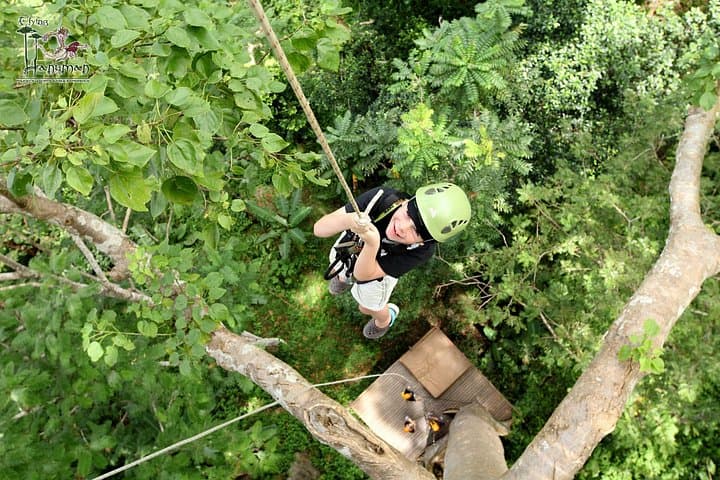
What the day feels like
You step off a wooden platform and the island exhales beneath you. The canopy trembles as your harness takes the first load, and for a wild second you are neither in Phuket’s crowded beaches nor its tuk‑tuk bustle — you are suspended above a tropical green that smells of damp earth, frangipani and distant sea. The world narrows to the cable beneath you and the guide’s calm voice in your ear. Then the forest pulls you forward.
Hanuman World’s zipline circuit is not a stunt for spectacle so much as a choreography with nature. Eighteen timber platforms are threaded through mature rainforest, linked by zips, sky‑bridges and rappels. The whole run is compact — a neatly paced two hours of adrenaline and observation — but it feels much larger because every line moves you into a new frame: a shuttering of leaf, a gap revealing low limestone ridges, a calmed view toward inland Phuket instead of the usual ocean postcard.
There’s an incongruous piece of culture braided into the adventure: Hanuman, the monkey‑god from the Ramayana (and its Thai telling, the Ramakien), is the park’s namesake. The mythic Hanuman is a fitting patron for an experience that celebrates nimbleness and courage; locals will tell you that the monkey’s bravery is as much a part of the park’s identity as its safety briefings.
Geologically, Phuket is a mix of granite lowlands and older limestone outcrops that have created the island’s undulating inland topography. The zipline routes take advantage of these modest elevations and the taller stands of trees that colonize the sheltered ravines. In the rainy months the forest acquires a particular sheen — leaves heavy with water, ephemeral pools reflecting the sky — and the whole place seems to hum with insects and birdcall.
Hanuman World sits inland from the beaches most travelers know. That placement means you trade surf panoramas for a closer look at Phuket’s wild side: gibbons are rare here, but long‑tailed macaques and a scatter of tropical birds are common sights and sounds. Guides double as naturalists, pointing out the occasional hornbill silhouette or a hidden medinilla bloom. More than a ride, the course functions like an interpretive slice of island ecology, one anchored in safety equipment rather than silence and stealth.
Practically speaking: this is a 120‑minute, professionally run zipline that starts with a safety orientation and fitting. You clip into steel cables with industry‑standard harnesses and helmets; experienced guides handle attachment points and brief you on body position, braking, and the signals used throughout the course. Routes are suitable for fit beginners and confident walkers alike, and because platforms are high in robust trees, the sensation is airborne but controlled.
Why choose this over a beach day? For one, perspective: Phuket’s character shifts inland, and the zipline reorients you to geography, flora and a different pace. For another, the cardio and focus required — short bursts of adrenaline followed by slower walking and observation — feel restorative in a way sunbathing rarely is. And finally, the infrastructure here is modern; if you want a high‑quality guided aerial adventure without long travel from major tourist hubs, this fits.
Booking notes and money matters: the product runs about two hours and is typically offered as an instant‑confirmation activity. Prices start around the low‑to‑mid $60s (USD), which includes equipment and instruction. Hanuman World emphasizes safety; expect harnesses, double‑clip systems, and on‑site staff who run the entire line. Free cancellation is often available through booking partners, but check specific vendor policies and any minimum‑guest requirements before you go.
Timing and pacing matter. Early mornings — before the heat builds — offer cooler air and crisper views; if you book midday in the hot season, be prepared for humidity and a more languid pace between lines. Rain can make some bridged sections slippery but does not automatically close every line; guides will make weather calls with safety as the priority.
For planning: go with closed‑toe shoes, a light daypack, and clothing you don’t mind getting a bit sweaty. Cameras are fine if tethered securely; many visitors opt for a phone or a small action camera attached with approved straps. If you’re traveling with kids or older family, ask the operator about minimum‑age or weight requirements — policies vary and are often generous for safety.
After the final zip and the return walk, your options are refreshment and reflection. The circuit ends with a short debrief and usually some time to sip water and swap highlights with other riders. From there you can head back to the beach towns, or linger at a local cafe to trade photos and compare perspectives: the same island, seen from a line instead of the sand, feels more intimate and, strangely, larger.
This zipline in Phuket is not just about the rush; it’s a way to access a corner of the island that many travelers miss, to practice a different form of attention, and to briefly be a creature in the canopy. If you want to feel the island’s inland pulse without committing to a long jungle trek, it’s one of the most efficient and rewarding ways to do so.
Trail wisdom
Small choices, better day.
Wear closed‑toe shoes
Secure footwear with good grip makes platform transitions and short walks safer and more comfortable.
Early slots beat the heat
Book a morning time to avoid midday humidity and softer light for photos.
Secure cameras with tethers
If you bring a phone or small camera, use a wrist or chest tether approved by staff to prevent drops.
Hydrate before and after
Two hours of activity in tropical weather is deceptively dehydrating — drink water before you clip in and afterward.
Local knowledge
Read the place, not just the route.
Watch for native species including Long‑tailed macaque, Various tropical birds (e.g., hornbills, kingfishers).
Keep an eye out for wildlife during the transition between areas and habitats. Respect distance guidelines.
Operators often run small‑scale conservation messaging—stick to paths, avoid feeding wildlife, and dispose of trash properly to protect the forest.
Follow the guide's instructions on size limits, ethical handling, and leave-no-trace practices.
Short forest walk near the course with shaded viewpoints and local wild ginger blooms. A small roadside stall serving coconut ice cream popular with locals near the park entrance
Locally recommended viewpoints and quiet spots known best to local operators.
The park’s name references Hanuman, the monkey‑hero of the Ramayana/Ramakien; the figure is woven into Thai cultural stories and local place‑names.
Maritime roots and regional tradition shape the waterways and working coasts.
Seasonal guide
Four versions of the same landscape.
Spring
Best forFewer storms · Clearer lines · Warmer water if combining with beach plans
ChallengesRising temperatures · Increasing humidity · Intermittent pre‑monsoon showers
March–May bring hot, humid days with generally reliable zip conditions early and occasional afternoon showers.
Summer
Best forLush green canopy · Lower prices in shoulder months · Fewer tourists
ChallengesMonsoon rains (June–Oct) · Shortened or altered runs in heavy rain · Higher humidity
June to August is wet season—expect dramatic rainstorms that can prompt schedule changes, but the forest is at its greenest.
Fall
Best forFewer crowds post‑monsoon · Cooler mornings · Dramatic skies
ChallengesResidual rainfall (Sept–Nov) · Trail muddiness · Variable conditions
Late monsoon to early dry season can still be wet, but the landscape is refreshed and light is excellent for photography.
Winter
Best forDry, cool weather · Stable operating conditions · Easy travel from beaches
ChallengesHigher tourist demand · Earlier booking needed · Slightly cooler mornings
December–February is the island’s high season with crisp air and consistent operating schedules—prime time for zipping.
Operator details
What the booking data adds.
Included
- ✓Hotel pickup and drop-off
- ✓First Aid Insurance.
- ✓All taxes, fees and handling charges
- ✓Entrance Tickets Zipline 18
Not included
- —Food and drinks.
- —Souvenir photos (available to purchase)
- —Gratuities
Good to know
- ✓Not recommended for travelers with spinal injuries
- ✓Not recommended for travelers with poor cardiovascular health
- ✓Not recommended for pregnant travelers
- ✓Travelers should have a high level of physical fitness
- ✓Not recomended for senior citizen above 60.
- ✓Not recomended for child below 4 years.
- ✓Weight below 40 Kg or above 120 Kg will not be allowed to participate.
Pack with intention
What to bring.
Good to know
Common questions.
The scheduled activity is approximately 120 minutes including safety briefing, gearing up and the full circuit across 18 platforms.
Plan the edges
The details that make the day easier.
Hanuman, the park’s namesake, is a central figure in the Ramayana and its Thai version the Ramakien—symbols and sculptures of Hanuman are common across Thailand and inspired the park’s theme.
After the zipline, head toward Phuket Town for toddy‑sweet roti stalls or to Patong for seafood by the water. Small local cafes near Kathu serve fresh coconut ice cream and grilled skewers—perfect for cooling down.
- Closest airport
- Phuket International (HKT). Typical driving time from Patong or Phuket Town: 25–45 minutes. Cell service: generally good on main roads, patchy in dense canopy. Permits: none, but book through an operator and check age
Support operators that limit single‑use plastics, stick to marked trails, and brief guests on not feeding wildlife—these small actions help protect Phuket’s inland forest.
Explore by topic
Follow the threads.
Keep exploring
Make the story part of the trip.
 Related story
Less than two hours from Nairobi, Kereita Forest pairs hands-on canopy adventure with quiet montane trails and a sobering colonial history—perfect for families, teams, and curious travelers seeking a full-day pulse of nature.
Set out from Bass Harbor for a private, customizable day on Blue Hill Bay — lighthouses, puffins, seals, and the chance to feel Acadia from the water. Small groups, local captains, unforgettable views.
In four hours you can move from shaded canyon ferns to wind-scoured coastal ridgelines, guided by someone who knows where the light—and the hidden views—live. This private half-day hike on the Monterey Peninsula or Big Sur is compact, curated, and perfect for travelers who want depth without a multiday commitment.