
What the day feels like
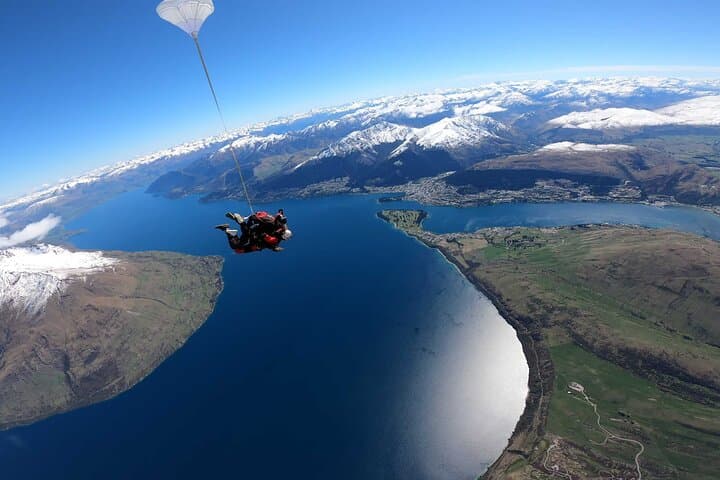
Morning breaks over Lake Wakatipu with a clean, alpine light. The mountains draw their hard lines against a high New Zealand sky, and the lake—ever-restless—breathes in its 27-minute rhythm. At the hangar, your harness clicks tight. A tandem instructor gives a steady nod, and the plane noses up into cold, laminar air. Queenstown shrinks to a tidy patchwork of rooftops and poplars, and the Remarkables shoulder into view like stone sentinels. The door slides open. Air surges in. The world invites you to step off into the slipstream.
Tandem skydiving in Queenstown condenses the region’s adventure DNA into a single, crystalline minute: freefall at around 200 km/h, then a quiet canopy glide with the Southern Alps fanned out beneath you. From altitude options typically at 9,000, 12,000, or 15,000 feet, you’ll choose your flavor of fear and joy—more height equals more freefall. Either way, the sequence is precise. A brief ground briefing. A short flight. Door, roll, arch, breathe. The planet reaches up, fast, but the horizon holds steady, and once the parachute blossoms overhead, the whole landscape exhales. Lake Wakatipu unfurls in its ice-carved Z-shape, the braided Shotover River scribbles pale blue through river gravels, and the Remarkables stand their post, watching everything.
Queenstown didn’t stumble into the adventure crown. It was earned. In the 1860s, miners chased gold through the Shotover—once called one of the richest alluvial gold rivers in the world—scratching a living from cold current and harder rock. A century later, a new kind of seeker arrived, drawn by ski lines and big air. When bungy jumped into global consciousness at the Kawarau Bridge in the late 1980s, the town doubled down on gravity. Skydiving followed, and today it remains one of Queenstown’s signature rites of passage: a clean, audacious way to measure yourself against the vertical scale of the Southern Alps.
The landscape tells a deeper story. These mountains are still rising, pushed up by the Alpine Fault, their schist shining at angles that make geologists grin. Glaciers carved Wakatipu’s trench, leaving that unmistakable dogleg that maps can’t help but trace. The lake even has a voice—a natural seiche that nudges its surface up and down by a few inches roughly every half hour. Local Māori tradition offers a legend of a sleeping giant whose heartbeat stirs the water; science points to wind and basin geometry. Either way, the lake keeps time.
A Queenstown skydive is more than the jump. It’s the way the westerlies hustle cloud off the peaks. It’s the hum of the prop as the plane climbs the ridgeline of air. It’s the instructor’s hand at your shoulder, steadying the moment before you both give the void what it wants. Then the drop. The air takes you with intent. Terminal velocity builds, and though your speed spikes, clarity follows: a sensory quiet formed by commitment. The ground is there, but distance feels abstract—what’s real is the push of wind on your chest, the instructor’s precise body positions, and the stack of mountains piling to every horizon.
When the canopy opens, the world unspools. Silence rushes in. You’ll trace lines over farmland and river terraces, looking down at the stitched greens and golds of Otago, with the Remarkables throwing their serrated shadow. Your instructor may offer gentle turns if conditions allow; the lake winks silver, the landing zone expands, and your legs move into the exact position you practiced minutes earlier. Touchdown comes soft, sometimes with a drift of dry field dust. The plane’s song fades. Your grin is ungovernable.
Here’s the practical spine beneath the poetry. Plan for three to four hours start to finish, including check-in, briefing, the drive or shuttle to the drop zone, gear-up, the flight to altitude, and return. Morning slots often see calmer winds and steadier weather; book early in your stay to allow a re-accommodation window if the famous Queenstown conditions flex. Dress for the mountain environment even in summer: layers, closed-toe shoes, and a willingness to feel the cold bite at altitude. Cameras are typically not allowed in freefall for safety—operators offer photo and video packages shot by onboard systems or hand-cam, and they’re worth it for the perspective alone. Age and weight restrictions apply; review the operator’s specifics when you book. If weather cancels your jump, expect clear, fair options to reschedule or refund.
Picking an altitude is part art, part budget, part appetite. The highest option yields the longest freefall, stretching the moment when gravity roars and the lake dares you to blink. First-timers often report that freefall feels shorter than the clock says—rush compresses time. The canopy ride restores it. On clear days, vistas reach toward Glenorchy, Cecil and Walter Peaks, and the distant white veils of the Main Divide.
Queenstown rewards the lingerers. After your jump, walk the lakeside path from Queenstown Gardens to watch the TSS Earnslaw puff across Wakatipu, or drive the short, scenic loop along Peninsula Road toward Kelvin Heights to trace your flightline from below. If your legs still want altitude, ride the Skyline Gondola for a dusk overlook when the lake steals the last light.
In the end, the skydive is less about conquering fear and more about partnering with a place that thrives on verticality. The mountains stand firm, the lake keeps its metronome, and the wind does what wind does—pushes forward. For a minute or so, you join that rhythm. And once your feet are back on Otago soil, the experience doesn’t fade; it recasts the landscape. Every time you glance up at the Remarkables, they look back with a knowing tilt, as if to say: you’ve seen us from our side now. That’s a souvenir you won’t misplace.
Trail wisdom
Small choices, better day.
Book the first flight of the day
Morning conditions are often more stable with lighter winds, giving you the best odds of flying on schedule.
Dress like it’s colder than town
Altitude bites—wear a base layer and closed-toe shoes even in summer; gloves can help on crisp days.
Know the restrictions
Age and weight limits apply and can affect availability or pricing; confirm details at booking to avoid day-of surprises.
Decide on media in advance
Personal cameras are usually not allowed in freefall; if you want footage, choose a photo/video package before takeoff.
Local knowledge
Read the place, not just the route.
Watch for native species including Australasian harrier (kāhu), New Zealand falcon (kārearea).
Keep an eye out for wildlife during the transition between areas and habitats. Respect distance guidelines.
Respect farmland and airfield boundaries around the drop zone. Choose operators with strong safety and environmental policies; pack out all waste.
Follow the guide's instructions on size limits, ethical handling, and leave-no-trace practices.
Kelvin Heights Sculpture Trail for lake-level views of your flight path. Sunset lookout on Coronet Peak access road for sweeping valley panoramas
Locally recommended viewpoints and quiet spots known best to local operators.
Queenstown’s modern adventure reputation grew from the 1860s gold rush and later innovations like commercial bungy at Kawarau Bridge in 1988.
Maritime roots and regional tradition shape the waterways and working coasts.
Seasonal guide
Four versions of the same landscape.
Spring
Best forCrisp visibility · Quieter crowds
ChallengesChangeable weather · Cool temps at altitude
October–November bring clear air and fresh snow on peaks. Expect fast-changing conditions and pack layers.
Summer
Best forStable flying conditions · Long daylight hours
ChallengesStrong UV · Busier schedules
December–February are prime for consistent jumps and warm ground temps—book ahead and wear sunscreen.
Fall
Best forGolden landscapes · Balanced temps
ChallengesOccasional wind shifts · Shortening days
March–April combine mellow weather with brilliant autumn color on the hillsides.
Winter
Best forSnow-capped vistas · Crisp, clear air
ChallengesCold at altitude · Weather cancellations
June–August deliver dramatic alpine views; bundle up and allow extra buffer days in case of weather holds.
Operator details
What the booking data adds.
Included
- ✓Courtesy coach to drop zone
- ✓All safety equipment
- ✓Safety briefing with jumpmaster
- ✓Tandem skydive
Not included
- —Freefall Photo & USB Video pack of skydive trip
- —Hotel pickup and drop-off
- —Food and drinks
Good to know
- ✓Wheelchair accessible
- ✓Infants and small children can ride in a pram or stroller
- ✓Not recommended for travelers with spinal injuries
- ✓Not recommended for pregnant travelers
- ✓Not recommended for travelers with poor cardiovascular health
- ✓Suitable for all physical fitness levels
- ✓Each passenger is required to complete a medical questionnaire prior to their skydive.
- ✓All persons over 95kg are subject to Tandem Master assessment at the drop zone.
- ✓The minimum weight is 40kg/88lbs and all passengers must be big enough to fit safely into the harness.
- ✓Passengers under 18 years of age must have written consent from a parent or guardian.
- ✓Risk Warning: Your participation in parachuting activities is inherently dangerous and may involve risks. These risks include, but are not limited to those arising from prevailing conditions such as weather or health conditions you may have. Despite careful packing, the parachute may open abruptly or not open correctly which may result in injury. Unintended incidents may occur during the aircraft flight, descent or on landing.
- ✓Parachuting is done at the parachutists' own risk. Any person parachuting, training to parachute, flying in any aircraft being used for parachuting or participating in any activity carried out by Skydive Wanaka or NZONE may only do so on the distinct understanding that they do so entirely at their own risk.
Pack with intention
What to bring.
Good to know
Common questions.
Plan on 3–4 hours including check-in, safety briefing, transport to the drop zone, the flight to altitude, and return.
Plan the edges
The details that make the day easier.
Lake Wakatipu experiences a natural seiche, causing the water level to rise and fall by about 20 centimeters roughly every 27 minutes.
Refuel at Fergburger for the town’s most famous post-adrenaline bite, then slide over to Atlas Beer Cafe on Steamer Wharf for local taps and lake views. Craving something sweet? Patagonia Chocolates does affogatos and ice cream with alpine views that go big on flavor.
- Closest airport
- Queenstown (ZQN). Check-in is typically in central Queenstown with shuttle to the drop zone near the airport (10–20 minutes). Cell service: Good in town and at the airfield. Permits: None required for participants; bring booking confirmation and valid ID. Allow 3–4 hours door to door.
This flight-based adventure has a carbon footprint—consider operators that offset emissions and keep your own impact low: stick to designated areas, minimize single-use plastics, and keep noise and litter off the airfield and farmland.
Explore by topic
Follow the threads.
Keep exploring
Make the story part of the trip.
 Related story
Less than two hours from Nairobi, Kereita Forest pairs hands-on canopy adventure with quiet montane trails and a sobering colonial history—perfect for families, teams, and curious travelers seeking a full-day pulse of nature.
Set out from Bass Harbor for a private, customizable day on Blue Hill Bay — lighthouses, puffins, seals, and the chance to feel Acadia from the water. Small groups, local captains, unforgettable views.
In four hours you can move from shaded canyon ferns to wind-scoured coastal ridgelines, guided by someone who knows where the light—and the hidden views—live. This private half-day hike on the Monterey Peninsula or Big Sur is compact, curated, and perfect for travelers who want depth without a multiday commitment.