
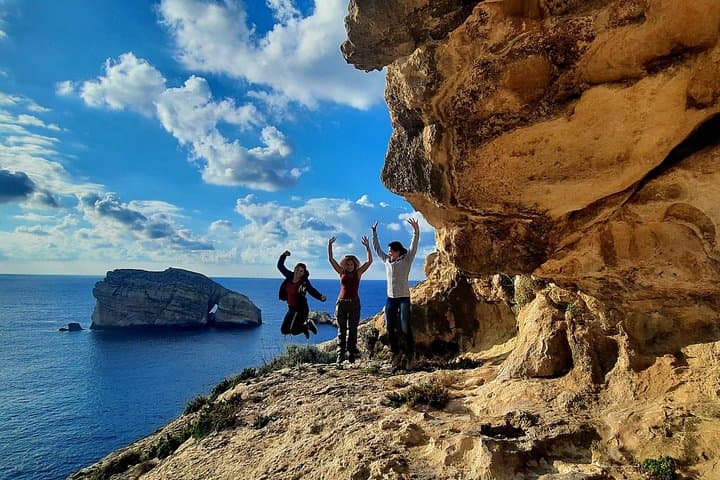
What the day feels like
The path rolls out in pale limestone, ribbed and warm from the sun, leading toward Xlendi Bay where the Mediterranean exhales against the cliffs. The sea doesn't whisper here—it presses forward, testing edges, daring you to keep pace as the trail swings above aquamarine coves and shadowed inlets. On Gozo, Malta’s quieter, greener sister island, a guided hike is less about conquering elevation and more about moving with the island’s rhythm: dry-stone walls guiding your steps, terraced fields folding into valleys, and old watchtowers keeping their silent appointments with the horizon.
This is Gozo Unveiled Hiking, a half-day, guide-led exploration tailored to your group’s energy and the day’s weather. One route might sketch the curves of Xlendi’s cliffline, brushing past thyme-scented garigue and pockets of chert tucked into limestone. Another might climb onto the Wardija plateau, where wind and time have left a Punic sanctuary sitting close to the sky—modest, weathered stones with a presence that outlasts explanation. Your guide adjusts based on the heat, wind, and your stride, linking viewpoints and heritage points into a flowing, 4.5-hour loop that feels both efficient and expansive.
Gozo’s geology is a layered story. You walk it underfoot: Lower Coralline Limestone lays a strong foundation, Globigerina Limestone softens the cliffs into terraces, and Upper Coralline caps the headlands into ramparts. Sea caves muscle into the coastline, arches form and fall (Dwejra’s Azure Window is gone now, yet the sea keeps sculpting), and the island’s edges stay on the move. Trails trace the safest margins of this change, but the cliffs still assert themselves—wind funnels hard on the headlands, and waves persist at your periphery, insisting you look up.
History doesn’t sit behind glass here; it waits beside the path. The Tal-Wardija Punic site, a small sanctuary perched above the coast, speaks to a Mediterranean crossroads older than the Romans. A short drive across the island, the megalithic Ġgantija Temples—UNESCO-listed and older than Stonehenge—underline how far back time runs in these stones. Even the coastal watchtowers, like the sturdy 17th-century Xlendi Tower, read as field notes from another era when corsairs prowled these waters. Your guide will know which fragments fit the day’s route and light, weaving context into viewpoints without slowing the pace.
Culturally, Gozo runs on a slower gear than mainland Malta. Farm plots still pinwheel around scattered farmhouses, village piazzas stir late with families, and bakery windows promise ftira—Gozitan-style bread layered with tomatoes, capers, and local olive oil. In the fields and on the high ground, you’ll hear the island speak through bells and wind. On the coast, you’ll see it in careful lines: the geometric salt pans above Xwejni, centuries-old, still catching the sea. Your hike puts you among these textures without numbing the senses with trivia. Instead, the island’s character arrives steadily: small shrines tucked into walls, prickly pears staking the hedges, terraced rubble carrying groundwater through dry months. Gozo doesn’t perform. It simply continues.
The walking itself is approachable but varied. Expect a mix of mellow village lanes, rugged footpaths, stepped limestone, and occasional narrow sections near cliff edges. Elevation is modest—think undulating rather than punishing—but the terrain demands attention. The rock can be slick with sea-spray or polished by boots. The sun, in summer, holds its gaze. Your guide pulls intelligent lines through it all, using wind direction and shade to keep the route comfortable. Water, hats, and grippy footwear aren’t suggestions here; they’re the price of admission.
Why hike Gozo, of all Mediterranean islands? Scale and intimacy. You can cross ridges to bays without a car; cliff-top and valley floor stay in conversation. The limestone architecture—natural and human—feels coherent, even as the sea keeps editing the coastline. In a single morning you can look into a faulted sea cave, walk above a fisherman’s stair, edge past wild fennel and rock samphire, and stand over a Punic-era site that compresses millennia into a few stones and a view. It’s compact and consequential. And because routes are flexible, you get Gozo in its best light—your guide adjusting for wind on the headlands or sheltering you through a valley if the mistral comes to test the cliffs.
By the time you loop back toward the finish, the island will have pressed its details into your memory: the grit of salt on the breeze, the honeyed tone of Globigerina layers, the way the coastline curves like a confident line drawn by a steady hand. The sea keeps urging forward; the island keeps setting its feet. You get to move between them, tuned in and awake, and return with something more than steps counted.
Practical notes: The hike runs about 4.5 hours, moderate in effort, with frequent breaks for photos and water. Spring delivers wildflowers and kinder temperatures; summer commands early starts, brimmed hats, and high-SPF sunscreen; autumn’s light is generous, with the occasional storm rolling through; winter is cool and clear, sometimes windy on exposed edges. Guides will tailor the route to your group’s fitness and interests, and while distances vary, expect a pace that keeps you moving without rushing the views. Bring 1.5–2 liters of water, sturdy shoes with traction, and a curiosity for stone, sea, and stories—Gozo has plenty of all three.
Trail wisdom
Small choices, better day.
Respect the edges
Cliffside sections can be narrow and windy. Keep a safe distance and follow your guide’s line.
Hydrate early and often
Carry 1.5–2 liters of water per person—shade is limited and the limestone reflects heat.
Footing matters
Limestone can be slick with spray or dust. Wear grippy, closed-toe footwear with good tread.
Wind-aware wardrobe
A light windbreaker helps on exposed headlands; sun protection is a must year-round.
Local knowledge
Read the place, not just the route.
Watch for native species including Cory’s shearwaters on evening flights, Maltese wall lizards basking on warm stone.
Keep an eye out for wildlife during the transition between areas and habitats. Respect distance guidelines.
Stay on established paths to protect fragile garigue and cliff-nesting seabirds. Leave no trace and avoid disturbing salt pans.
Follow the guide's instructions on size limits, ethical handling, and leave-no-trace practices.
Xlendi Tower for a balcony over the bay. Xwejni Salt Pans’ honeycomb geometry near Marsalforn
Locally recommended viewpoints and quiet spots known best to local operators.
Gozo’s coastal towers date to the 17th century, while the Wardija area preserves traces of Punic-era ritual life above the sea.
Maritime roots and regional tradition shape the waterways and working coasts.
Seasonal guide
Four versions of the same landscape.
Spring
Best forWildflowers · Mild temperatures
ChallengesIntermittent wind · Occasional showers
Green hills and blooms with comfortable hiking weather. Some days bring brisk coastal winds.
Summer
Best forCrystal-clear sea views · Long daylight
ChallengesHigh heat · Strong sun exposure
Start early to beat heat. Expect bright light, limited shade, and warm, dry trails.
Fall
Best forGolden light · Warm water for post-hike swims
ChallengesChance of storms · Variable winds
Calmer crowds and warm days with occasional squalls. Routes may adjust for weather.
Winter
Best forCrisp air · Clear views
ChallengesCool winds on cliffs · Shorter days
Quiet trails and steady hiking weather. Pack a light layer and check wind forecasts.
Operator details
What the booking data adds.
Included
- ✓One complimentary drink is included.
Not included
- —Alcoholic Beverages
Good to know
- ✓Service animals allowed
- ✓Not recommended for travelers with spinal injuries
- ✓Travelers should have at least a moderate level of physical fitness
- ✓The trail is subject to change according to wind conditions to avoid disappointment and ensure maximum enjoyment. The pictures represent different paths around Gozo. Please feel free to ask.
Pack with intention
What to bring.
Good to know
Common questions.
Plan for about 4.5 hours at a moderate pace. Expect uneven limestone paths, some steps, and occasional narrow sections near cliffs.
Plan the edges
The details that make the day easier.
Gozo’s Ġgantija Temples are among the world’s oldest freestanding stone structures, predating Stonehenge and the Egyptian pyramids.
Post-hike, refuel in Xlendi at Ta’ Karolina or The Boathouse for fresh lampuki (seasonal) and Ġbejna cheeselets. In Victoria, try a ftira from a local bakery and cap the day with a craft pint at Lord Chambray Brewery in Xewkija. If time allows, wander the Cittadella at sunset for wide-open views across terraced fields.
Gozo’s coastal habitats host nesting seabirds and rare garigue plants—stay on marked paths, pack out all waste, and avoid loud noise near cliffs.
Explore by topic
Follow the threads.
Keep exploring
Make the story part of the trip.
 Related story
Less than two hours from Nairobi, Kereita Forest pairs hands-on canopy adventure with quiet montane trails and a sobering colonial history—perfect for families, teams, and curious travelers seeking a full-day pulse of nature.
Set out from Bass Harbor for a private, customizable day on Blue Hill Bay — lighthouses, puffins, seals, and the chance to feel Acadia from the water. Small groups, local captains, unforgettable views.
In four hours you can move from shaded canyon ferns to wind-scoured coastal ridgelines, guided by someone who knows where the light—and the hidden views—live. This private half-day hike on the Monterey Peninsula or Big Sur is compact, curated, and perfect for travelers who want depth without a multiday commitment.