
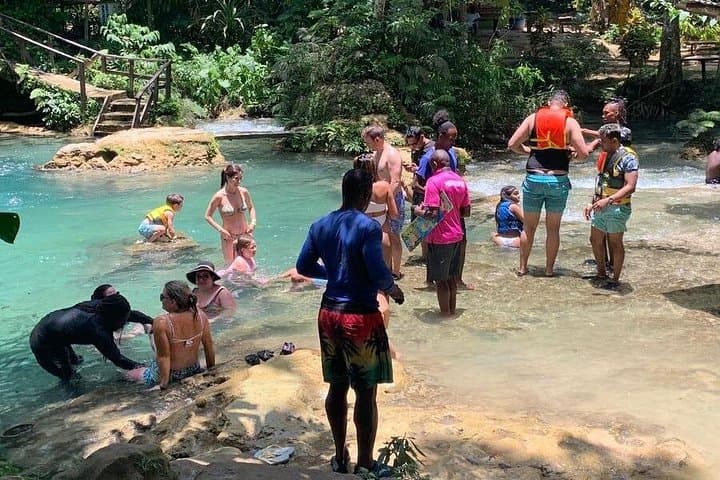
What the day feels like
You get to the parking strip before the trail—minivans sighing in the heat, guide folding a map into a pocket, the island air already damp with sugarcane and sea. The path to Blue Hole narrows fast into a green tunnel; sunlight slashes through leaves and the sound of moving water grows from a whisper into an immediate presence. By the time you step out onto stone warmed by the sun, the falls have found you: a sequence of natural pools cupped like bowls between boulders, each one a different color of blue. The river, not content to be scenery, dares you forward—into cool plunge pools, behind curtains of water, over ledges where locals still leap with an easy grin.
This is not a manicured, rope-lined attraction. Blue Hole—called Island Gully Falls or Secret Falls by guides—feels like an invitation to play in a landscape that has been shaping itself for millennia. The limestone and boulder-strewn river folds and refolds, creating deep pockets for swimming and shallow shelves for sunning. Caves ring like mouths you can duck behind; moss claims every shaded seam. Your guide reads the line of rocks like a conductor, pointing out the safest jump spots and offering a hand where the current grows cheeky.
A short drive away, Konoko Falls Park changes the mood from rugged to cultivated. Here, paths wind through a botanical garden once part of a colonial estate. A small museum preserves artifacts and tells the story of Jamaica’s indigenous Taino people; the river here is gentler, a place to learn as much as to splash. Konoko’s terraces and viewpoints fold out into panoramas of Ocho Rios’ coast—an abrupt, human-made contrast to the more wild Blue Hole.
Geology does the heavy lifting around Ocho Rios. Rivers have carved channels into limestone and bauxite for eons, and intermittent rains send water surging through narrow gorges, producing the abrupt drops and emerald basins you see at Blue Hole. Culture hangs close to the landscape: Konoko’s exhibits connect the waterfalls and gardens to the Taino who tended and traveled these waterways long before colonization, while the surrounding coastline later became an axis for trade, plantations, and, eventually, tourism.
Practicality keeps the day honest. Tours like this run 3–4 hours—ample time to swim, climb a few modest jumps, meander through Konoko’s gardens, and still be back in Ocho Rios for dinner. It’s best as a single-day adventure from town; most operators include pickup and drop-off in an air-conditioned minivan. Expect a mix of rugged footing and flat trails, a few sets of stairs at Konoko, and short rock scrambles at Blue Hole. Both sites are managed with local staff; bring cash for tips and small entrance fees if they’re not included in your booking.
Safety is straightforward but non-negotiable: wear water shoes for traction, use reef-safe sunscreen (the pools and downstream life are fragile), and follow your guide’s route—those smooth rocks bite the unprepared. Swimming skills matter; even calm pools have sudden drop-offs. For photographers, the light tilts golden late in the afternoon and reflections sharpen in stiller basins; early morning visits reduce crowds and let you claim quieter corners.
Why pick this combo instead of just one fall? Blue Hole delivers play—cliff jumps, hidden caves, and that wading-in-to-cool-off feeling—while Konoko provides context. Together they feel like a balanced day: the body gets its dose of motion and adrenaline; the mind gets the story of place. For families, the variety keeps different energy levels engaged. For solo travelers and small groups, the guided format is a low-friction way to access terrain that can feel disorienting if you go it alone.
Timing matters. Jamaica’s dry season (roughly December to April) keeps rivers lower and safer for scrambling; the wet months make slides slicker and currents stronger. Arrive early to avoid the midday crowds and the heat that slaps your energy flat. Hydrate before you dive, stow valuables in a dry bag, and bring a small tip envelope—local guides rely on gratuities and often double as informal naturalists and photographers for your group.
Beyond the logistics, there’s a softer reward: water that shapes behavior. The river forces a slower cadence; you step, balance, breathe. Laughter echoes against rock faces. Guides share lineage and legends between instructions, so a splash becomes anthropology. You leave with wet hair and salt-smooth skin and the kind of memory that’s tactile, not just visual.
If you go, treat the site as if you were invited into someone’s home. Pack out any waste, avoid chemical sunscreens, and consider spending an extra hour in Ocho Rios afterward—supporting local food vendors or artisans is among the best ways to repay the day’s kindnesses. With a little preparation and curiosity, a few hours at Blue Hole and Konoko Falls becomes the kind of day that enlarges what you thought a tropical afternoon could be.
Trail wisdom
Small choices, better day.
Wear water shoes
Traction is essential on mossy limestone and river rocks—avoid sandals with slippery soles.
Bring a dry bag
Keep phone, cash, and sunscreen tucked away while you swim and jump.
Listen to your guide
Local guides know safe jumping lines and changing currents—follow instructions for every cliff and pool.
Use reef-safe sunscreen
Prevent chemical runoff from damaging freshwater ecosystems—apply before arrival.
Local knowledge
Read the place, not just the route.
Watch for native species including Green heron, Freshwater crabs and native river fish.
Keep an eye out for wildlife during the transition between areas and habitats. Respect distance guidelines.
Both Blue Hole and Konoko depend on local stewards; avoid soap or lotions in pools, use reef-safe sunscreen, and pack out trash to help protect freshwater habitats.
Follow the guide's instructions on size limits, ethical handling, and leave-no-trace practices.
A quiet upstream pool reached with your guide where light filters through a narrow gorge. A lookout terrace at Konoko that frames Ocho Rios’ coastline—best near late afternoon for soft light
Locally recommended viewpoints and quiet spots known best to local operators.
Konoko Falls Park sits on grounds that were once part of a colonial estate and includes a small museum and exhibits about Jamaica’s indigenous Taino people.
Maritime roots and regional tradition shape the waterways and working coasts.
Seasonal guide
Four versions of the same landscape.
Spring
Best forLower crowds · Warmer water · Botanical blooms
ChallengesIntermittent showers (May marks wetter months) · Some trails may be damp
Late spring still feels warm and pleasant; visit early before the heavier rains begin and enjoy blooming garden sections at Konoko.
Summer
Best forWarm water · Long daylight hours · Lush foliage
ChallengesHigher chance of heavy rain · Stronger currents after storms
Summer brings vibrant green growth and warm swim temps but also short, intense downpours—check weather and avoid visiting right after heavy rains.
Fall
Best forFewer tourists · Good value on tours · Comfortable temperatures
ChallengesPossible storm activity during hurricane season (Aug–Oct) · Variable water levels
Autumn can be quieter and pleasant; stay aware of tropical weather forecasts during the peak of hurricane season.
Winter
Best forDry days · Stable river conditions · Clearer views
ChallengesCooler mornings · Busier holiday periods
The dry season offers the most consistent footing and safest jumping conditions—arrive early to beat crowds during peak tourist months.
Operator details
What the booking data adds.
Included
- ✓WiFi on board
- ✓Air-conditioned vehicle
- ✓Hotel/port pickup and drop-off
Not included
- —Blue Hole Admission (50USD)
- —Konoko Falls & Park Admission (10USD)
- —Dirt Adventure Admission (50USD)
Good to know
- ✓Infants and small children can ride in a pram or stroller
- ✓Public transportation options are available nearby
- ✓Specialized infant seats are available
- ✓Not recommended for travelers with spinal injuries
- ✓Not recommended for pregnant travelers
- ✓Not recommended for travelers with poor cardiovascular health
- ✓Suitable for all physical fitness levels
- ✓Minimum of 2 people per booking is required for this tour
Pack with intention
What to bring.
Good to know
Common questions.
Typical tours last about 3–4 hours, including travel time from central Ocho Rios, time at Blue Hole, and a guided visit to Konoko Falls Park.
Plan the edges
The details that make the day easier.
Konoko Falls Park includes exhibits about the Taino people and is situated on the grounds of a former colonial estate that later became a botanical garden.
After a day of swimming, head into Ocho Rios for jerk chicken at Scotchies or fresh seafood along the waterfront; try a cold rum punch and browse local craft stalls for woven goods and rum cake.
- Closest airport
- Sangster International (MBJ) in Montego Bay (~1.5-hour drive). Trailhead: Blue Hole parking near the village outside central Ocho Rios (~20 minutes by car). Cell service: Good in town, patchy near some river gorges. Permits: No formal permits—entrance fees or guide fees may apply depending on the tour.
These freshwater systems are sensitive—avoid soaps or sunscreen with oxybenzone, pack out all trash, and follow local guide instructions to reduce erosion and habitat disturbance.
Explore by topic
Follow the threads.
Keep exploring
Make the story part of the trip.
 Related story
Less than two hours from Nairobi, Kereita Forest pairs hands-on canopy adventure with quiet montane trails and a sobering colonial history—perfect for families, teams, and curious travelers seeking a full-day pulse of nature.
Set out from Bass Harbor for a private, customizable day on Blue Hill Bay — lighthouses, puffins, seals, and the chance to feel Acadia from the water. Small groups, local captains, unforgettable views.
In four hours you can move from shaded canyon ferns to wind-scoured coastal ridgelines, guided by someone who knows where the light—and the hidden views—live. This private half-day hike on the Monterey Peninsula or Big Sur is compact, curated, and perfect for travelers who want depth without a multiday commitment.