
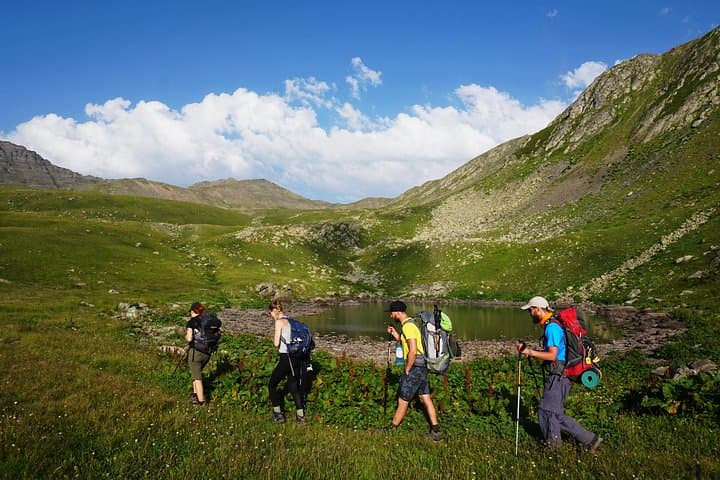
What the day feels like
By the time the van drops you at the foot of the trail, the mountains have already started talking. They don't shout; they shift—ridges breathing lightly, streams arranging themselves into lively conversation, clouds gathering like gossip over the summits. Camp Caucasus sits somewhere in that dialogue, a short-running camp with a long memory: a week of meadows and waterfalls, wooden shelters and family kitchens, and a three-day push toward thin air at roughly 3,000 meters. For six days you follow a route that feels both wild and familiar—the kind of trip that rewires how you think about a 'short' escape.
Day one is a soft introduction: a 12-kilometer hike to a waterfall that announces itself before you see it—first the cadence of falling water, then the mist on your face. Forested switchbacks give way to grazed alpine meadows dotted with wildflowers; the path narrows and opens like a chapter turning. Here, the streams dare you to pause, their cold fingers pushing forward as you refill a water bladder and swap a story with the guide. You sleep in a family-owned guesthouse that night—wood smoke, home-cooked stews, and the comfortable clatter of plates—an easy cultural immersion into Georgian mountain hospitality.
The next three days are where the country strips its gentleness and shows a sterner side: roughly 50 kilometers across alpine terrain with daily gains that flirt with 3,000 meters. Expect long ridge walks, loose scree, and several short steep pitches. The geology reads like an atlas of collision—folded limestones, jagged volcanic outcrops, and moraines left by ancient glaciers. Mountains in the Caucasus are personalities: some brusque, some mellow. On this itinerary they are both collaborator and demanding teacher. You shelter in basic mountain huts and refuges, learning how a sleeping bag and a quiet hour under a vast sky can make a person content.
Culture stitches the landscape together. Horse rides to hilltop fortresses and tower houses—many constructed in the middle ages—remind you these slopes have been lived on and defended for centuries. The Svaneti towers—vertical stone guardians—are less romantic relics and more practical statements of survival against raids and weather. Evenings are about food and language; kubdari (meat-filled bread) appears like ritual, chacha like a salute. Guides from Camp Caucasus translate not only words but priorities: respect the land, share the table, and know when to move quietly through a village.
Practically speaking, this is not a walk in the park. The trek’s hardest days require steady legs, a head for altitude gain, and a tolerance for changing weather. Trails alternate between packed dirt, grassy ridgelines, and loose scree. Temperatures can swing widely—warm sun at lower elevations and bone-chilling wind at high camps. But the logistics are tidy: small-group structure, a local support crew, transfers between trailheads, and a single fixed start and finish over six days. Viator lists the tour price from USD 1,171.06 and a scheduled departure in late June 2025—prime time for wildflowers and firm but not icy terrain.
Why go? For the landscape that insists on being noticed: rivers that cut laughing lines through the valleys, meadows that feel like quilts under your boots, and peaks that stand like old monuments. For the people who keep these traditions alive—guesthouse cooks who know how to turn a few ingredients into a memorable supper, guides who read the weather like neighbors read morning news. And for the simplicity of moving on foot for several days, carrying only what you truly need. The trip hands you a very particular kind of luxury: time.
How to prepare: train for consecutive long days with elevation gain—think long weekend hikes with a loaded pack; practice on scree and uneven footing; and get accustomed to single-digit sleep temperatures. Pack layers, quality boots, and a good rain shell. Hydration and pacing are non-negotiable: altitude is gradual but insistent. Lastly, carry cash for small purchases and gratuities; support local guesthouses and porters where possible.
On the trail, move deliberately. Start early on summit days to beat afternoon winds, sip water regularly rather than gulping, and conserve energy on the steeper pitches by using poles and shorter steps. Respect local rhythms—ask before photographing inside a guesthouse, and accept (and reciprocate) invitations for tea.
This sort of trip rewards more than endurance; it rewards curiosity. When you step out of a shelter onto a dawn-lit ridge and the valley below exhales fog, you'll understand why travelers return: mountains reveal what you brought along—both the physical gear and the quieter readiness for their company. Camp Caucasus merely invites you into the conversation.
Trail wisdom
Small choices, better day.
Start Summit Days Early
Begin high-elevation hikes at dawn to avoid afternoon wind and storms and to enjoy firmer terrain.
Use Trekking Poles
Poles reduce knee stress on steep descents and help steady you on loose scree sections.
Hydrate Often
Sip small amounts frequently—altitude effects are cumulative and hydration helps acclimatize.
Carry Local Currency
Small guesthouses and markets may not accept cards; have cash for food, tea, and tips.
Local knowledge
Read the place, not just the route.
Watch for native species including Bearded vulture (occasionally overhead), Chamois or ibex on steeper slopes.
Keep an eye out for wildlife during the transition between areas and habitats. Respect distance guidelines.
Visitors support local economies by staying in family guesthouses—pack out what you pack in, keep to marked trails, and avoid disturbing grazing areas.
Follow the guide's instructions on size limits, ethical handling, and leave-no-trace practices.
Early-morning walk to a lesser-known meadow for sunrise and a quiet view of the valleys. A family-run cheese producer near the first guesthouse—ask your guide for a tasting
Locally recommended viewpoints and quiet spots known best to local operators.
The Svaneti region is dotted with medieval tower houses and fortresses that date back to the Middle Ages and once served both as defense and family symbols.
Maritime roots and regional tradition shape the waterways and working coasts.
Seasonal guide
Four versions of the same landscape.
Spring
Best forWildflower displays · Lower-crowd hiking · Cool daytime treks
ChallengesLate snow patches · Muddy trails
Spring brings awakening meadows and fewer people, but higher passes may still hold snow and some routes can be muddy or slushy.
Summer
Best forStable weather windows · Full alpine blooms · Accessible high passes
ChallengesOccasional afternoon storms · Busier guesthouses
Summer is ideal for reaching 3,000-meter saddles and enjoying long daylight; carry sun protection for exposed ridgelines.
Fall
Best forClear views · Crisp mornings · Fewer crowds
ChallengesShorter days · Colder nights
Fall yields clear air and color but cooler temperatures and potential early snow at elevation—plan for warm layers.
Winter
Best forSki-touring (expert) · Snow-sculpted landscapes
ChallengesRoute closures · High avalanche risk · Limited services
Winter is only for experienced, well-equipped parties; most summer multi-day itineraries are not feasible due to snow and logistics.
Operator details
What the booking data adds.
Included
- ✓Local guides
- ✓Private transportation
- ✓Accommodation in guesthouse and mountain shelters on the trail.
- ✓Lunch
- ✓Dinner
- ✓Breakfast
- ✓Horses with full equipment and guides
- ✓Registration for Russian border passing.
- ✓Grill party
- ✓Help in equipment planning and gear rent.
Not included
- —Money for extra things in grocery or souvenirs and for Saturday expenses and meals in Sighnaghi.
- —Mountain insurance till 3000m
- —Basic equipment: Backpack, hiking boots or sport shoes and etc.
- —Flight tickets
Good to know
- ✓Public transportation options are available nearby
- ✓Infants are required to sit on an adult’s lap
- ✓Not recommended for travelers with spinal injuries
- ✓Not recommended for pregnant travelers
- ✓Not recommended for travelers with poor cardiovascular health
- ✓Travelers should have at least a moderate level of physical fitness
- ✓This adventure does not need any specific skills to have. Requires a minimum of equipment, average physical fitness level and a wish to let your spirit be adventurous.
Pack with intention
What to bring.
Good to know
Common questions.
This is a small-group departure—expect a handful of travelers for a low-impact experience and easier logistics.
Plan the edges
The details that make the day easier.
Upper Svaneti, the highland area around Mestia, is a UNESCO World Heritage Site noted for its medieval defensive tower houses and unique cultural landscape.
After a day on the trail, head into Mestia for hearty Svanetian dishes—kubdari (spiced meat bread) and chvishtari (cheese cornbread)—and a glass of chacha. Guesthouses often serve the best, locally sourced meals; support family-run places when possible.
- Closest airport
- Mestia (Queen Tamar) Airport; Major international airports: Tbilisi or Kutaisi. Driving time: ~4–8 hours from major cities depending on route. Cell service: patchy to none in high valleys. Permits: none required for standard routes; local guide recommended.
This itinerary supports local guesthouses and uses existing trails—pack out non-biodegradable waste, avoid disturbing pastureland, and consider offsetting travel emissions.
Explore by topic
Follow the threads.
Keep exploring
Make the story part of the trip.
 Related story
Less than two hours from Nairobi, Kereita Forest pairs hands-on canopy adventure with quiet montane trails and a sobering colonial history—perfect for families, teams, and curious travelers seeking a full-day pulse of nature.
Set out from Bass Harbor for a private, customizable day on Blue Hill Bay — lighthouses, puffins, seals, and the chance to feel Acadia from the water. Small groups, local captains, unforgettable views.
In four hours you can move from shaded canyon ferns to wind-scoured coastal ridgelines, guided by someone who knows where the light—and the hidden views—live. This private half-day hike on the Monterey Peninsula or Big Sur is compact, curated, and perfect for travelers who want depth without a multiday commitment.