
What the day feels like
The tram car nudges away from the platform and the city slips back like a receding tide. Below, the Rio Grande threads through winter cottonwoods; ahead, the Sandia Mountains rear up, a granite wall rimmed in white. When the doors open at the crest, the air sharpens, thin and clean. Snow sighs underfoot. Pines huddle against the wind like old friends, and the mountain seems to invite you to slow your breathing and listen.
This is Albuquerque, winter edition: a place where you can sip green chile stew downtown at lunch and crunch across a high alpine ridge by afternoon. The Albuquerque Snowshoe Experience pairs the Sandia Peak Tramway with a guided snowshoe tour of the crest, letting the lift do the heavy work before your guide eases you onto the winter canvas.
The terrain up here is a study in contrasts—broad, wind-brushed meadows followed by pockets of sheltered forest where the snow stacks deep and soft. Sunlight pours across the crest and the city gleams to the west, an unfurled map beyond the edge of the world. On calm days, the quiet is complete, a vast hush broken only by your own steps and the distant bark of a raven. In gusty moments, the wind shouldering the ridge tells you who's in charge; it nudges your jacket and pushes you toward the lee side of the trail.
Guides stitch the outing with meaning as you go. The Sandias are the eastern wall of the Rio Grande Rift, a block of resilient granite lifted skyward over millions of years, their pink hue at sunset earning the name “sandía,” or watermelon. In winter, the mountain trades its summer perfume of sun-warmed piñon for the clean scent of snow and fir. Rosy-finches—rare visitors elsewhere—treat the crest like a seasonal canteen, flashing through the cold light in tight, jittery flocks. Mule deer pick quiet lines through the timber, leaving a hieroglyph of tracks in fresh powder. Up here, everything adapts; even the snow seems to learn to cling, bent into sculpted cornices and glittering crust.
The tramway that makes this alpine access possible has its own story. Since 1966, the Sandia Peak Tramway has eased locals and travelers from desert to skyline, spanning roughly 2.7 miles from base to crest. The cabin swings over granite arroyos and frozen waterfalls, giving you a preview of the terrain that will crunch beneath your snowshoes. It’s one of those rare transitions that feels like time travel—fifteen minutes and you’re an altitude world away.
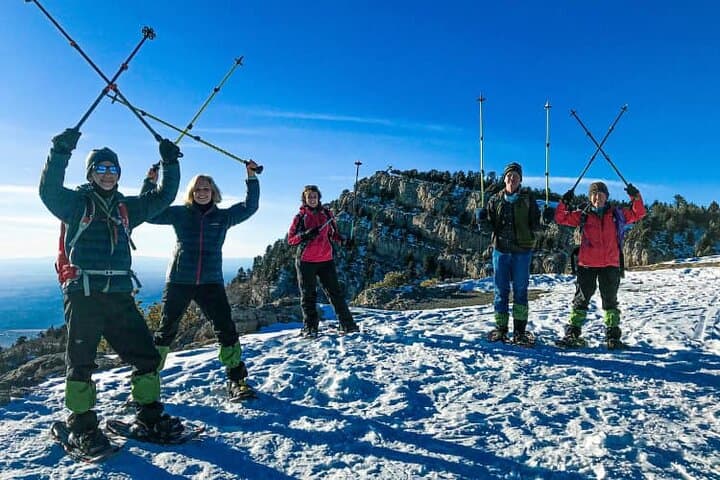
Once you’re moving, the rhythm of snowshoeing takes over—steady, deliberate, oddly meditative. The route varies with conditions but typically ranges from 2 to 4 miles along sections of the Crest Trail, with 200–400 feet of rolling elevation change at roughly 10,300 feet. Guides share practical cues: widen your stance a hair, keep steps short on steeps, use poles to stay balanced if the snow has set up crusty. On sheltered stretches, you might lay first tracks through powder that puffs around your gaiters; on sunlit edges, the snow might squeak, each step a dry note in the cold.
Then comes the simplest pleasure: a stop tucked out of the wind, hands wrapped around a steaming cup of cocoa. The heat works from the fingers inward as you look out over the West Mesa and the volcanoes beyond, tiny black cones rising from the plain. Up here, the horizon feels closer to the bones. Your guide points out the Kiwanis Cabin—a New Deal-era stone hut standing sentry along the crest—and notes how this ridge shelters life all year long, even now.
Practicalities keep this high-country dream grounded. Winter in the Sandias changes fast; sunlit calm can turn to a ridge-top rattle in an hour. Dress with intention: moisture-wicking base, insulating mid-layer, windproof shell. Waterproof boots are non-negotiable. Sunglasses or goggles fight glare that bounces off every white surface, and sunscreen matters even more at altitude. Hydration can sneak past you in the cold; drink before you’re thirsty. Albuquerque sits around 5,300 feet, but the crest tops 10,000, and your lungs will notice. Pace early; the mountain rewards patience.
Timing matters, too. Morning brings firmer snow and quiet tram cars; afternoon light paints the city in subtle pinks and long, slanting shadows. Tram operations are weather dependent, and wind can ground cars—always check advisories before you go. As for the tour itself, guided means you get local knowledge and current snow intel; routes are chosen to match the day’s conditions and the group’s comfort.
And then there’s the culture wrapped around the stone and snow. The Sandia Mountains are sacred to the people of Sandia Pueblo. Treat the crest with humility and respect—pack out everything, tread lightly, and stay on durable surfaces to protect delicate subalpine plants just under the snow. Back in town, that respect can extend to how you celebrate the day: warm up with New Mexican staples and toast a skyline you’ve now walked above.
As the tram glides back toward the city and the cold peels away from your face, it hits you what a gift this is: winter you can step into and out of in an afternoon, a simple loop that rearranges your sense of place. The Sandias don’t shout; they beckon. They ask you to breathe deeper, move slower, and let the high-country quiet do its work. If you answer, the ridge answers back—with views that stretch into next week and snow that carries your story a step at a time.
Trail wisdom
Small choices, better day.
Mind the Altitude
You’ll be moving around 10,000 feet; start slower than you think and sip water regularly to stave off headaches and fatigue.
Dress in True Layers
Wear a wicking base, warm mid-layer, and windproof shell—then fine-tune at stops so sweat doesn’t chill you when you rest.
Protect Your Eyes
Snow glare is fierce at elevation—bring polarized sunglasses or low-light goggles for shaded forest sections.
Check Tram Wind Advisories
High winds can pause operations; confirm status the morning of your tour and build in buffer time.
Local knowledge
Read the place, not just the route.
Watch for native species including Rosy-finch (winter flocks along the crest), Mule deer browsing in sheltered timber.
Keep an eye out for wildlife during the transition between areas and habitats. Respect distance guidelines.
You’re traveling in Cibola National Forest; stay on durable surfaces, pack out all waste, and avoid trampling subalpine vegetation hidden beneath thin snow.
Follow the guide's instructions on size limits, ethical handling, and leave-no-trace practices.
Kiwanis Cabin, a stone shelter along the crest with sweeping views over the city. Ellis Trail meadows on the east side, often loaded with soft, quiet snow
Locally recommended viewpoints and quiet spots known best to local operators.
Opened in 1966, the Sandia Peak Tramway spans about 2.7 miles and has long been one of the longest aerial tramways in the Americas.
Maritime roots and regional tradition shape the waterways and working coasts.
Seasonal guide
Four versions of the same landscape.
Spring
Best forLate-season snowshoeing · Bluebird ridge views
ChallengesVariable melt-freeze crust · Mud and ice mix on approaches
March and early April can deliver lingering snow with stronger sun. Expect firmer mornings and softening snow by midday.
Summer
Best forTram sightseeing · Wildflower ridge hikes (no snowshoes)
ChallengesNot a snowshoe season · Afternoon thunderstorms
While this product focuses on winter, summer is prime for tram rides and crest hikes. Watch for monsoon storms and start early.
Fall
Best forCrisp air and early dustings · Quieter trails
ChallengesUnpredictable first snows · Shorter daylight
October–November can bring the season’s first light snows and clear views. Snowshoeing may be possible after early storms.
Winter
Best forConsistent snowpack · Lowest crowds midweek
ChallengesWind exposure on the crest · Very cold wind chills
December–February are the sweet spot for reliable snowshoe conditions. Dress warm, manage layers, and watch tram weather holds.
Operator details
What the booking data adds.
Included
- ✓Hot Cocoa
- ✓Hand Warmers
- ✓Parking & Round-Trip Tickets for the Sandia Peak Tramway
- ✓Carrying Bag with Back Strap
- ✓Bottled water
- ✓Snowshoe Poles
- ✓High-Quality Snowshoe Rentals
- ✓Snacks
- ✓Snow Gaiters
Not included
- —Gratuities
Good to know
- ✓Not recommended for travelers with poor cardiovascular health
- ✓Suitable for all physical fitness levels
Pack with intention
What to bring.
Good to know
Common questions.
Plan for 4–5 hours total, including the tram ride and a guided snowshoe route of roughly 2–4 miles depending on conditions.
Plan the edges
The details that make the day easier.
At roughly 2.7 miles long, the Sandia Peak Tramway is the longest aerial tramway in the Americas, climbing from about 6,500 to 10,378 feet in one span.
After descending, thaw out with a bowl of green chile stew and fresh tortillas at El Pinto or Sadie’s. Craft beer fans should hit La Cumbre Brewing for a celebratory Elevated IPA. On-mountain, Ten 3 offers hot drinks with standout views—perfect if winds pick up and you want a warm vantage point before the ride down.
- Closest airport
- Albuquerque International Sunport (ABQ), ~25 minutes to the tram base. Trailhead: Sandia Peak Tramway upper terminal. Drive time from Old Town Albuquerque: ~25–30 minutes to the base. Cell service: Generally good at the base; spotty along the crest. Permits: No forest permit for snowshoeing; separate tram ticket required. Weather holds possible—build in a buffer.
You’re traveling on a high-use alpine ridge—pack out everything, stay on consolidated snow to protect fragile plants below, and carpool or rideshare to reduce parking congestion and emissions at the base.
Explore by topic
Follow the threads.
Keep exploring
Make the story part of the trip.
 Related story
Less than two hours from Nairobi, Kereita Forest pairs hands-on canopy adventure with quiet montane trails and a sobering colonial history—perfect for families, teams, and curious travelers seeking a full-day pulse of nature.
Set out from Bass Harbor for a private, customizable day on Blue Hill Bay — lighthouses, puffins, seals, and the chance to feel Acadia from the water. Small groups, local captains, unforgettable views.
In four hours you can move from shaded canyon ferns to wind-scoured coastal ridgelines, guided by someone who knows where the light—and the hidden views—live. This private half-day hike on the Monterey Peninsula or Big Sur is compact, curated, and perfect for travelers who want depth without a multiday commitment.