
What the day feels like
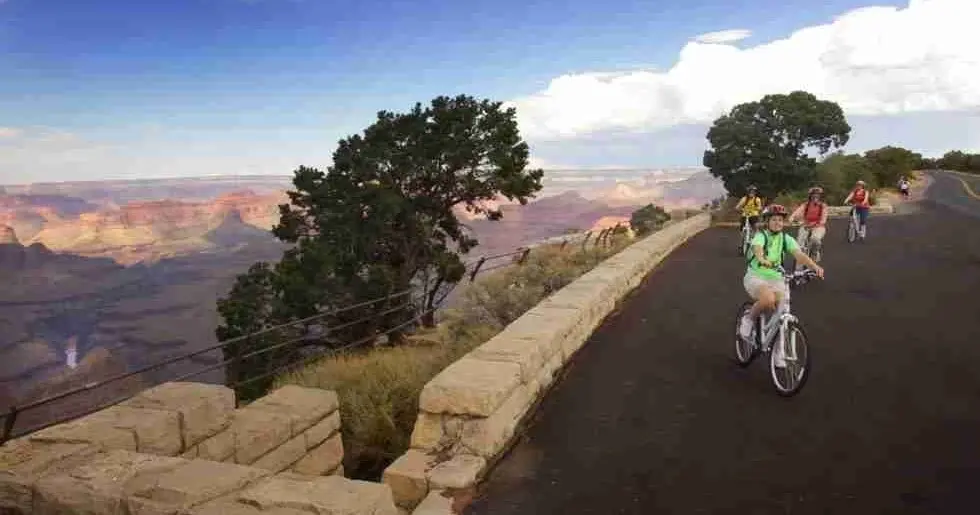
The morning light arrives like a slow spill over the South Rim, stroking the stone into color—rose, rust, and a deep canyon violet that only appears before the day fully wakes. Tires click into place. A raven rides the thermals above the pinyon pines, croaking like it knows the route by heart. And then you’re rolling—freewheeling west along Hermit Road, a nearly car-free ribbon that hugs the Grand Canyon’s edge and teases with glimpses of the Colorado River flashing far below.
This is the joy of the Hermit Road Tour: three unhurried hours and 5.5 miles of rimside riding, where the canyon isn’t just a view—it’s a presence riding alongside you. The pavement undulates with the terrain, asking for an easy rhythm. The wind carries hints of juniper and sun-warmed dust. The canyon, never shy, performs its scale in real time: miles-wide amphitheaters, house-sized boulders softened by distance, and the improbable green thread of the river hustling through the schist.
With a seasoned guide leading the way, the ride becomes both adventure and conversation. At Powell Point, the story of exploration feels near—this is where John Wesley Powell’s legacy is honored, the geologist-soldier whose boat expeditions in 1869 and 1871 mapped the unknown. Farther on, you might pause at The Abyss, a sheer drop that dares your stomach to peer over. Pima Point offers more than views; when the wind is right, the river’s voice carries up the cliffs, a faint roar reminding you that water drives the canyon’s narrative. It pushes forward, insists on change, and every layer of rock tells the history of the push.
Hermit Road itself carries history. In the early 1900s, the Santa Fe Railway developed the west rim corridor as a scenic route to Hermit Camp. Architect Mary Colter later designed Hermit’s Rest in 1914, a rustic stone-and-timber shelter that feels born from the rock itself. Today, the road is closed to public vehicles most of the year, a thoughtful decision that gives cyclists, pedestrians, and shuttle riders more room to breathe. That translates to quiet riding, birdsong, and viewpoints that don’t require elbowing your way to the front.
Geology here isn’t background; it’s protagonist. The banded walls read like a library of time—Kaibab Limestone at the top, sandstones and shales stepping down toward the canyon’s core, and the ancient Vishnu Schist near river level, rock that remembers nearly two billion years. Your guide’s interpretation syncs with the landscape as you pedal: brief stops that fit the group’s pace, clear explanations that turn the scenery into a story you can actually follow.
Culture is woven into the rim as well. The Grand Canyon is sacred to many Indigenous communities, including the Havasupai, Hopi, Hualapai, Navajo, and Zuni, among others. Respect here isn’t optional—stay on established paths, give wildlife ample space, and keep voices low at overlooks. This is a place where silence holds weight.
The Hermit Road Tour is designed to be accessible. Most riders with basic cycling comfort will find the rolling terrain manageable, though the 7,000-foot elevation adds a little bite to each rise. The pace is friendly; breaks are plentiful; the canyon is patient. Kids are welcome as long as they can follow instructions and keep the group rhythm. Bikes and helmets are provided, and the two-way shuttle removes any stress about backtracking.
Practicality keeps the ride enjoyable. Sun is a persistent companion, even in cooler months—layer strategically and carry water you’ll actually drink. Summer brings monsoon afternoons with fast-moving storms; lightning rules are taken seriously. Winter can glaze the rim pathways with ice and cut the wind sharp; spring and fall are the sweet spots when the sun is flattering and the crowds thin. Wildlife works the edges: elk browsing near Trailview Overlook, mule deer slipping through ponderosa, and if luck and timing allow, a California condor carving circles too wide for a hawk.
Local insights matter here. Start earlier in the day for softer light and easier traffic at the overlooks. Don’t skip Maricopa Point—its narrow peninsula makes the canyon feel like it’s leaning in to meet you. Pima Point is a highlight, especially if you can hear the river. And remember, the canyon gives what it wants in terms of visibility; dust or distant wildfire smoke may mute the horizon. The reward is a moody, layered portrait that photographs beautifully with a polarizer and a steady hand.
If you’re new to guided rides, leaning on reputable <a href="https://app.advcollective.com/local-experts/undefined">Grand Canyon local experts</a> takes the guesswork out. They’ll dial in bike fit, set a comfortable cadence, and handle logistics like timing, shuttle, and safety briefings. It’s also the best way to fold real interpretation into the experience—context that elevates what you’re seeing. Curious about routes, conditions, and family-friendly pacing? Tap a trusted <a href="https://app.advcollective.com/local-experts/undefined">local guide</a> who rides this road daily and knows when to linger and when to roll.
The ride ends, as good rides do, with that satisfied fatigue that lands in your legs and lingers in your grin. The canyon keeps its secrets, but on Hermit Road, it shares just enough—shifting light, the river’s distant rush, ravens drafting the rim—so you leave with something you didn’t have when you started: the feeling of having pedaled beside a living landscape that meets you stride for stride.
Trail wisdom
Small choices, better day.
Start Early for Softer Light
Morning rides mean cooler temps, calmer winds, and golden light on the canyon layers—ideal for both comfort and photos.
Hydrate at Altitude
At 7,000 feet, dehydration sneaks up fast. Sip regularly and bring at least 1–2 liters of water per person.
Mind the Rolling Hills
Hermit Road is mostly gentle but includes short rises. Shift early, keep a steady cadence, and don’t chase on the climbs.
Wildlife Has Right of Way
Elk and mule deer often cross the road; give them space and avoid sudden swerves. Keep 25 yards from all wildlife.
Local knowledge
Read the place, not just the route.
Watch for native species including Elk, California condor.
Keep an eye out for wildlife during the transition between areas and habitats. Respect distance guidelines.
Hermit Road is closed to most private vehicles much of the year to reduce congestion and protect the rim environment. Practice Leave No Trace and keep a safe distance from wildlife.
Follow the guide's instructions on size limits, ethical handling, and leave-no-trace practices.
Maricopa Point’s narrow peninsula view. Pima Point for river sound on windy days
Locally recommended viewpoints and quiet spots known best to local operators.
Hermit’s Rest was designed by architect Mary Colter in 1914 for the Santa Fe Railway, blending stone and timber to echo the canyon’s geology.
Maritime roots and regional tradition shape the waterways and working coasts.
Seasonal guide
Four versions of the same landscape.
Spring
Best forCool temps · Clear views
ChallengesWindy afternoons · Unpredictable storms
Mild temps and thinner crowds make spring prime for relaxed rides and crisp canyon visibility.
Summer
Best forLong daylight · Wildlife activity at dawn/dusk
ChallengesIntense sun · Afternoon monsoon storms
Start early to beat heat and potential thunderstorms; hydrate and carry a light rain shell.
Fall
Best forStable weather · Soft golden light
ChallengesCool mornings · Occasional smoke haze from distant fires
Arguably the best season—comfortable temps and photogenic light all day long.
Winter
Best forQuiet overlooks · Striking snow-on-red-rock contrast
ChallengesIcy patches · Cold winds on the rim
Bundle up and check conditions; icy sections may require slower riding and extra caution.
Pack with intention
What to bring.
Good to know
Common questions.
The tour covers roughly 5.5 miles along paved Hermit Road with gentle rolling hills and frequent scenic stops.
Plan the edges
The details that make the day easier.
Hermit’s Rest, the western terminus of the route, was designed by famed architect Mary Colter in 1914 and is listed on the National Register of Historic Places.
Post-ride, refuel at the Arizona Room or El Tovar Lounge in Grand Canyon Village for rim-view dining, or head to Grand Canyon Brewing Co. in nearby Tusayan for a cold pint and wood-fired comfort food. If you’ve got energy to spare, stroll the historic Verkamp’s Visitor Center and the Kolb Studio to connect the ride to the canyon’s cultural backdrop.
- Closest airport
- Flagstaff Pulliam (FLG), ~80 miles; Phoenix Sky Harbor (PHX), ~3.5–4.5 hours by car. Trailhead
- Meet-up
- Grand Canyon Visitor Center area, 10 S. Entrance Road. Driving: From Grand Canyon Village, it’s a short shuttle or drive to the meet-up; Tusayan is ~7 miles south. Cell service: Limited along Hermit Road. Passes: A valid Grand Canyon National Park entrance fee
Hermit Road’s limited private vehicle access preserves the rim experience and reduces wildlife disturbance. Pack out all trash, stay on paved paths and overlooks, and keep the canyon’s soundscape intact by speaking softly at viewpoints.
Explore by topic
Follow the threads.
Keep exploring
Make the story part of the trip.
 Related story
Aksla is the small mountain that makes Ålesund legible: 418 steps, sweeping panoramas, and a short tour that threads architecture and coastline into 90 minutes of memorable sightlines. Perfect for anyone who wants a quick, high-reward encounter with Norway’s west coast.
 Related story
The New York Public Library’s Main Branch is more than a photo stop—it's a civic living room, an architectural landmark, and a waypoint for walking tours that stitch together Midtown’s history, films, and holiday rituals. Here's how to make the most of a visit.
 Related story
Five miles of riverfront walking that reveal NYC’s quieter rhythms—Riverside Park pairs easy urban hiking with history, birdlife and a front-row view of the city’s climate resiliency efforts. Walk a stretch or follow the Greenway; either way, the Hudson makes its presence felt.