
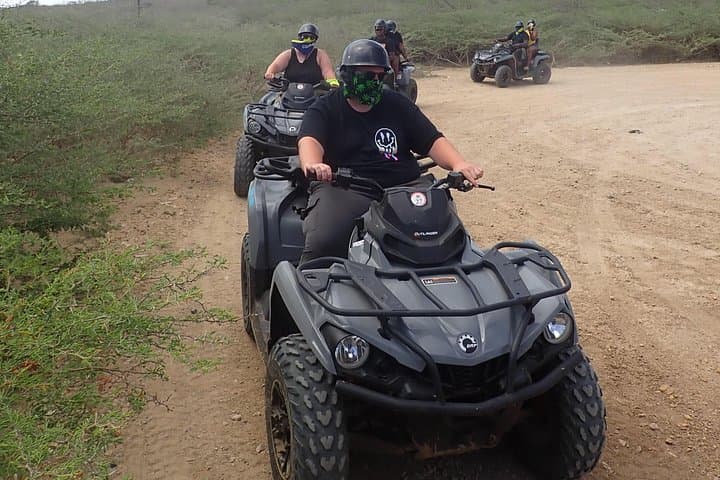
What the day feels like
The engine hiccups, then settles into a steady chug—the kind that promises both rumble and control. Salt wind cuts the air, carrying the cheer of gulls and the distant slap of surf against limestone. You kick the throttle and the road turns to a powdery ribbon: coral-sand tracks that wind past divi-divi trees bent by trade winds, past crumbling stone walls that mark the skeletons of old plantations, and finally open to a green-and-blue horizon where the Caribbean dares you to dive in.
This is western Curaçao on an ATV: a half- or full-day pass into a landscape where geology, history and the sea collide. The island’s western end feels like a different planet from the pastel streets of Willemstad—xeric scrub, dramatic coastal bluffs, and coves that still feel like discoveries rather than Instagram backdrops. Your guides know the lines: which goat paths will hold, where a boulder hides a view, and the small inlets where you can shed mud and heat for a salty swim.
Geology is part of the show. Curaçao’s bedrock is Pleistocene limestone—ancient reef and coral elevated and sculpted by wind and waves. From your seat on the ATV you can see the layered terraces etched into the coastline, evidence of sea-level change over millennia. The scrub and cacti that dot the route are survivors adapted to a semi-arid climate; rains are short but intense, and channels cut by flash flows still appear in washes across the track.
History threads through this terrain. Scattered ruins—stone cisterns, walls and the occasional colonial foundation—hint at plantations that once tried to wring a living from the island’s thin soils. Curaçao’s cultural mix is visible everywhere: Dutch colonial architecture in Willemstad, African influences in cooking and music, and a language—Papiamentu—that blends Portuguese, Spanish, Dutch and African words into a sing-song that accompanies island life.
The ride itself is straightforward but satisfying. Top-of-the-line ATVs are set up for both first-timers and those who want to push harder. Routes typically include a mix of packed dirt, coral sand, rocky outcrops and short technical sections around boulders and washes. The payoff is frequent: cliffside panoramas at lookout points, quiet beaches that invite a midday plunge, and a sense of going where the road dwindles and the island feels private.
Practical realities matter here. The tour lasts four to six hours—enough time to see a broad swath of western Curaçao but not so long that energy flags. Bookings are capped at small groups (maximum ten), which keeps the experience personal and minimizes ecological impact. Guides brief riders on safety, hand signals and how to read the terrain—essential for a safe, fun outing. Bring a swimsuit for a sea dip, but also sun protection and closed-toe shoes that can handle sand and gravel. Expect intermittent cell coverage once you leave the main roads.
Why choose an ATV for this corner of the island? It’s efficient and immersive. You cover ground faster than on foot, but you’re still exposed to the elements—the smell of dry brush, the rocking cadence of the rig, the unexpected flash of a lizard slipping into shade. For photographers, the mobility lets you chase light and angle; for families or mixed-ability groups, the ability to drive or ride passenger opens the island to non-hikers or people who just want to feel the wind.
Sustainability is part of the conversation on tours like this: operators limit group size, stick to established tracks, and emphasize Leave No Trace principles. The west coast’s marine life—including sea turtles that nest and feed near the rocky inlets—relies on mindful visitors who don’t disturb turtle foraging zones or litter the shore.
If you go, time your ride for morning or late afternoon. Midday heat is real, and early light brings softer shadows and calmer seas for that post-ride swim. After the tour, continue the local thread: sample keshi yena (cheese-stuffed meat) or freshly grilled fish in a seaside eatery; a cold Balashi beer tastes like a reward.
An ATV tour across western Curaçao is not about conquering terrain; it’s about getting close to the island’s edges—geological, cultural and scenic. It’s a ride that sings of coral limestone, of sea-salted wind, and of hands-on discovery. Whether you’re chasing cliff-top panoramas, an off-the-beaten-track beach, or just the simple pleasure of throttle and sky, this half- or full-day adventure delivers a compact, high-value taste of Curaçao’s wilder side.
Trail wisdom
Small choices, better day.
Bring layered sun protection
Wide-brim hat under your helmet, high-SPF sunscreen and UV-blocking sunglasses keep you comfortable on exposed coastal tracks.
Wear closed-toe shoes
Sneakers or light trail shoes protect feet from sand, coral fragments and hot footpegs during stops.
Hydrate and pace yourself
Carry at least 1–2 liters of water and sip often—there’s little shade on many western trails.
Follow your guide’s line
Stick to predetermined routes to protect flora and avoid unstable terrain; guides know where to ride and where to walk the machines.
Local knowledge
Read the place, not just the route.
Watch for native species including Sea turtles (often seen near rockier coves), Green iguanas and a variety of reef and coastal birds.
Keep an eye out for wildlife during the transition between areas and habitats. Respect distance guidelines.
Operators limit group sizes and stick to established tracks; visitors are asked to avoid disturbing shorelines and to pack out all waste to protect turtle nursery areas.
Follow the guide's instructions on size limits, ethical handling, and leave-no-trace practices.
Kleine Knip (a smaller, less crowded cove near the western coast). Playa Piskado (a turtle-habitat cove where fishermen and turtles share the shoreline)
Locally recommended viewpoints and quiet spots known best to local operators.
Western Curaçao bears remnants of colonial plantations and stone cisterns; the island’s mix of Dutch and Afro-Caribbean culture stems from its colonial and maritime history.
Maritime roots and regional tradition shape the waterways and working coasts.
Seasonal guide
Four versions of the same landscape.
Spring
Best forWarmer water swims · Fewer crowds than winter · Wildflower blooms after rains
ChallengesOccasional short rain squalls · Strong midday sun
Spring offers pleasant temperatures and good visibility for coastal views; pack a light rain layer and strong sun protection.
Summer
Best forLowest hotel rates · Long daylight hours · Calmer early mornings
ChallengesHotter daytime temps · Potential for brief tropical showers
Summer brings hot, dry weather ideal for early rides; expect afternoon heat and occasional quick downpours.
Fall
Best forGolden afternoon light · Less tourist traffic · Good sea visibility for swims
ChallengesIncrease in short, heavy showers · Higher humidity
Fall can be an excellent shoulder season for late-day rides but be prepared for sudden showers and muddy track sections.
Winter
Best forCooler trade winds · Peak visibility and calm seas · Best overall riding conditions
ChallengesHigher tourist numbers · Higher prices
Winter (Dec–Apr) is prime: steady trade winds, comfortable riding temperatures and clearer seas—book early to secure spots.
Operator details
What the booking data adds.
Included
- ✓Light refreshments
- ✓Local guide
- ✓Bottled water
- ✓Use of helmet
- ✓ATV tour
Not included
- —Gratuities
- —Hotel/port pickup and drop-off
Good to know
- ✓Travelers should have at least a moderate level of physical fitness
- ✓Children must be accompanied by an adult
- ✓Minimum age is 5 years and must ride with parent
- ✓Must have a valid driver's license in order to operate the ATV( Must bring driver's license)
- ✓Cruise ship passengers must provide the following information at time of booking: ship name, docking time, disembarkation time and re-boarding time
- ✓Refunds will not be issued if tour/activity is missed due to late or non-arrival of cruise ship
- ✓Recommend you bring sunscreen, wear sunglasses, wear adequate clothing (long pants and long sleeves are preferred)
- ✓Participants MUST be 30 minutes before the starting time.
Pack with intention
What to bring.
Good to know
Common questions.
Most operators require a valid driver’s license for those who will operate an ATV; passengers do not need one but must follow safety briefings.
Plan the edges
The details that make the day easier.
The Historic Area of Willemstad, Curaçao’s capital, is a UNESCO World Heritage Site known for its colorful Dutch colonial architecture.
After the ride, head back toward Willemstad for local flavors: try keshi yena (stuffed cheese) or fresh grilled fish with pan bati (cornbread). In the city, the Pietermaai district has lively bars and restaurants, while Plasa Bieu offers authentic local plates.
- Closest airport
- Curaçao International Airport (CUR). Driving time to western trailheads: ~45–60 minutes (40–55 km). Cell service: intermittent in remote west. Permits: none typically required; operator may require driver’s license and waiver.
Stay on marked tracks, avoid touching or stepping on coral, and carry out all trash—respecting nesting and feeding areas for sea turtles helps preserve the coastline.
Explore by topic
Follow the threads.
Keep exploring
Make the story part of the trip.
 Related story
Less than two hours from Nairobi, Kereita Forest pairs hands-on canopy adventure with quiet montane trails and a sobering colonial history—perfect for families, teams, and curious travelers seeking a full-day pulse of nature.
Set out from Bass Harbor for a private, customizable day on Blue Hill Bay — lighthouses, puffins, seals, and the chance to feel Acadia from the water. Small groups, local captains, unforgettable views.
In four hours you can move from shaded canyon ferns to wind-scoured coastal ridgelines, guided by someone who knows where the light—and the hidden views—live. This private half-day hike on the Monterey Peninsula or Big Sur is compact, curated, and perfect for travelers who want depth without a multiday commitment.