
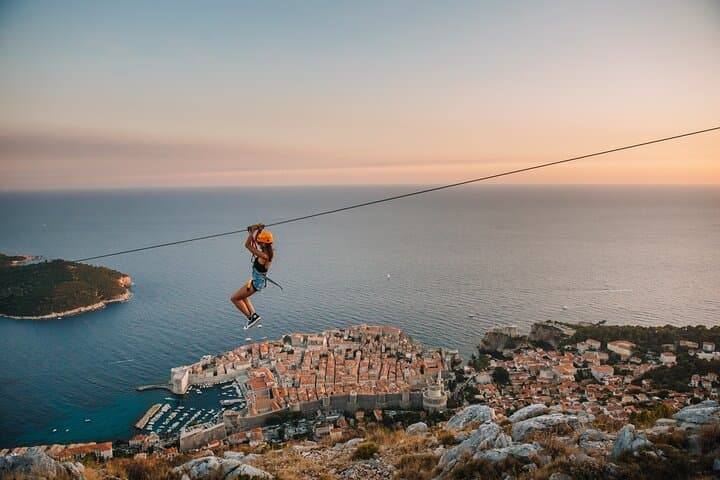
What the day feels like
The wind greets you first—salted by the Adriatic, quick with a dare—as you clip into the line high above Dubrovnik’s terracotta rooftops. The Old Town’s famed walls ring the city like a steady heartbeat below, while Lokrum Island lounges in the blue, pretending not to watch. A guide nods, the pulley hums, and you step into the open. The hillside falls away. Gravity takes the lead, the sea flashes a grin, and for a few clean seconds the world moves at your speed.
This is the Panorama Zipline experience above Dubrovnik, a simple equation of cable, harness, and cliffside vista that multiplies into far more than the sum of its parts. Here, the city’s medieval geometry becomes a map you can hold in your eyes: church domes, the grid of limestone lanes, the black commas of kayaks edging the walls. The line draws an arrow across that view and invites you to follow.
The setting is an education in stone and story. Dubrovnik rose on karst—hard, folded limestone shaped by water and time—so the slopes you step across are stitched with low holm oak, fragrant maquis, and the occasional shy tortoise. Above it all stands Mount Srđ, the city’s lookout since long before it became a destination. Fort Imperial, the Napoleonic-era stronghold on the summit, has watched over every chapter: Ragusan traders charting the Adriatic, the 1667 earthquake that reshaped the city, and the 1991–92 siege when the hillsides crackled with a different kind of tension. Flying here folds those narratives into the present—history drawn as contour lines under your feet.
Local guides keep the mood easy and the safety uncompromised. They brief you clearly—hands, posture, braking—and give you time to breathe into the height. Harness lines chatter as riders come and go, laughter spilling as often as adrenaline. The incline trails between launch points double as micro-hikes: a few minutes of walking on rocky track and terrace steps, the pines doing their part to provide shade. The sea is never out of view; even the wind has an opinion, nudging you forward, leaning into your momentum, sometimes hushing the hillside to let the gulls have the last word.
Timing shapes the experience. Mornings bring a softer light, the Old Town brushed in pale gold while the air is still cool. Late afternoon rides land you squarely in golden hour, when the rooftops ignite and the fortress stones warm from within. Summer heat demands strategy—hydrate, go early or late—while spring and fall bring breezier, quieter days. Winter, when operations run, can be a gift: bright skies after rain, the sea a darker, glossier blue, and fewer crowds to share it with.
Dubrovnik’s culture is never far from the edge of the cable. At the end of your run, you’re minutes from a plate of peka—slow-cooked veal or octopus under an iron bell—and the Dingač and Pošip wines that have powered local toasts since the Ragusan Republic had an embassy network that put modern diplomats to shame. The city’s layered identity—merchant, maritime, meticulously independent—shows up in details: the carved stone coats of arms, the measured pace of the Stradun, the way locals will debate gelato with academic rigor. A zipline can’t tell the whole story, but it hands you a cliff-note version with the rooftops spread like a chapter.
Practicalities steer the day. Closed-toe shoes make the short walks comfortable; a small daypack keeps your hands free for the line and the camera. Most providers run small-group departures with transfers from central Dubrovnik—often near the cable car station or a designated pick-up point—so you can leave the parking puzzle to someone else. Expect around 2.5 to 3 hours for the full experience, including briefing, multiple rides, and transfers. Age and weight limits apply; if you’re on the border, check before you book. If you fly with a phone, tie it down with a lanyard case; the wind has a thief’s touch, and the hillside will not return what it takes.
Beyond logistics, the value is in contrast. Few cities reward you with such an immediate aerial perspective. You see the Old Town as a whole—where kayakers thread the shore below Lovrijenac Fortress, how the wall-walk bends with the coastline, how the city’s medieval grid gives way to modern neighborhoods further out. On the line, you’re moving fast enough to feel it, slow enough to notice. The sea teases with a change of color from sapphire to teal over shallows; a kite hovers and edits your frame; the bell tower keeps its own time, unimpressed by your velocity.
If you arrive early, stand still before you fly. Listen to the cicadas stitch their summer song through the scrub. Smell the resin in the pines. Watch a ferry angle toward Gruž Port and imagine the centuries in which this was the view of homecoming for sailors. Then step in, clip on, and give the hillside its due. When you land, gravity returns what it borrowed, the guide grins, and you realize you’ve learned something spatial: a mental map that alters how you walk the city afterward. Later, when you trace the wall, you’ll look up at the ridge and know the exact pocket of air you flew through—and the Adriatic, ever playful, will wink again.
For travelers seeking a clean, high-return dose of Dubrovnik—views, story, motion—this zipline delivers. It’s both invitation and orientation, a reminder that the best vantage points often ask you to meet them halfway and let go for a moment. Bring sturdy shoes, a calm head for heights, and the curiosity to see the city as a living topographic map. The cable is waiting, humming its line, pointing straight at the heart of a place that keeps rewriting itself in light.
Trail wisdom
Small choices, better day.
Go Early or Late
Book morning or golden-hour slots for cooler temperatures and softer light on the Old Town and sea.
Secure Your Essentials
Use a phone lanyard and zippered pockets; the wind will happily collect anything loose.
Footwear Matters
Wear closed-toe shoes with grip for short rocky walks between platforms.
Hydrate Smart
Bring water, especially in summer; shade can be sparse on the karst hillside.
Local knowledge
Read the place, not just the route.
Watch for native species including Peregrine falcons riding thermals, Balkan wall lizards sunning on warm stone.
Keep an eye out for wildlife during the transition between areas and habitats. Respect distance guidelines.
The hillside’s Mediterranean scrub and limestone terraces are fragile; stay on marked paths, respect wildlife, and avoid flying drones near UNESCO-protected areas.
Follow the guide's instructions on size limits, ethical handling, and leave-no-trace practices.
Fort Imperial’s museum on Mount Srđ for context on Dubrovnik’s recent history. Park Orsula viewpoint for a quiet, elevated look at the Old Town and coastline
Locally recommended viewpoints and quiet spots known best to local operators.
Fort Imperial atop Mount Srđ was built in 1810 during Napoleon’s rule and later played a key role during the 1991–92 siege of Dubrovnik.
Maritime roots and regional tradition shape the waterways and working coasts.
Seasonal guide
Four versions of the same landscape.
Spring
Best forWildflowers and greenery · Mild temperatures
ChallengesUnpredictable showers · Gusty bora winds
Fresh, green hills and clearer air make spring ideal for views, though windy days can affect operations.
Summer
Best forLong daylight · Vibrant coastal colors
ChallengesHeat and strong sun · Peak crowds
Start early or aim for late afternoon to avoid heat; book ahead during July–August when demand spikes.
Fall
Best forGolden light · Calmer crowds
ChallengesShortening days · Occasional storms
Warm seas and mellow weather create excellent flying conditions with fewer visitors than midsummer.
Winter
Best forCrisp visibility · Quiet city
ChallengesCool temps · Weather-related cancellations
When open, winter rides can deliver dazzling clarity; dress warm and confirm departures on breezy or rainy days.
Pack with intention
What to bring.
Good to know
Common questions.
Yes. Guides provide a thorough briefing and manage all equipment; you’ll receive clear instructions for posture and braking before your first ride.
Plan the edges
The details that make the day easier.
Dubrovnik’s Old Town walls stretch nearly 2 kilometers (about 1.24 miles) and have protected the city since the 13th century; the ensemble is a UNESCO World Heritage site (inscribed in 1979).
Post-flight, head to Konoba Dubrava on Mount Srđ for traditional peka (reserve ahead), or ride the cable car for a celebratory drink at Restaurant Panorama with full-bay views. Down in the Old Town, grab a glass of Pošip at D’vino Wine Bar or find a cliffside seat at Buža Bar for sunset over the Adriatic.
- Closest airport
- Dubrovnik (DBV), ~30 minutes by car to the Old Town. Typical meeting point: near the cable car station or a central pick-up arranged by your operator. Drive time from Old Town to launch area: ~10–15 minutes. Cell service: generally good on the ridge. Permits: none for participants; check operator for age
This ridge overlooks a UNESCO World Heritage site and sensitive Mediterranean scrubland—stay on established paths, pack out all trash, and keep noise low to avoid disturbing birds of prey that nest in the cliffs.
Explore by topic
Follow the threads.
Keep exploring
Make the story part of the trip.
 Related story
Less than two hours from Nairobi, Kereita Forest pairs hands-on canopy adventure with quiet montane trails and a sobering colonial history—perfect for families, teams, and curious travelers seeking a full-day pulse of nature.
Set out from Bass Harbor for a private, customizable day on Blue Hill Bay — lighthouses, puffins, seals, and the chance to feel Acadia from the water. Small groups, local captains, unforgettable views.
In four hours you can move from shaded canyon ferns to wind-scoured coastal ridgelines, guided by someone who knows where the light—and the hidden views—live. This private half-day hike on the Monterey Peninsula or Big Sur is compact, curated, and perfect for travelers who want depth without a multiday commitment.