
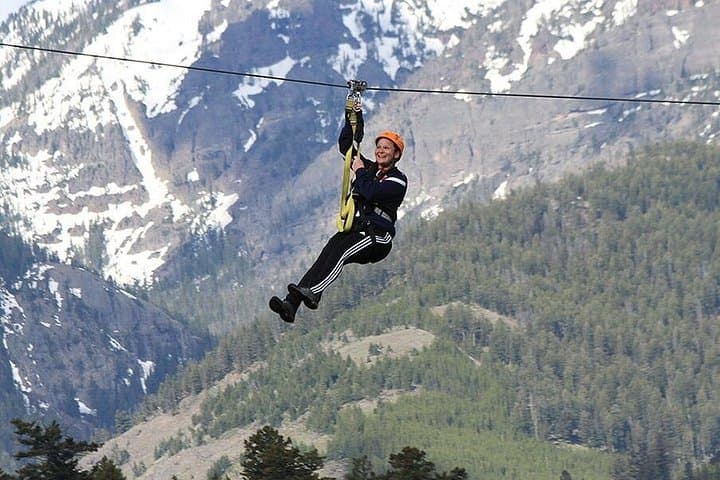
What the day feels like
You climb into the harness at the lip of a pine-scented ridge and the valley exhales below you. The first cable hums; the world opens into a patchwork of sage, balsam and silvered river. Everything seems to lean toward the park boundary—the smell of warm earth, the lowing of distant cattle, and the river that dares you to follow. For three hours the land insists on movement: weight meets wire, and for a few seconds you’re a body in motion—part machine, part bird—skimming over a historic Montana ranch and the high-country vistas that bleed into Yellowstone National Park. This is the Yellowstone Zipline EcoTour at the Ranch, an aerial shortcut to the landscape that made the West a story.
The tour runs across the Stermitz Ranch, a working property whose fences and hayfields speak to a century of ranching life on Yellowstone’s doorstep. Geologically this corridor is a hinge between volcanic highlands and river-carved valleys: basalt outcrops and glacial alluvium create abrupt drops and sweeping views that make for dramatic zipline runs. Culturally, this is cattle-country, but it’s also a corridor for elk and birds that move seasonally between park and prairie. Your guides point out carcass-scrubbed cottonwoods and the places where beaver once reworked the stream—small histories written in water and wood.
What makes the EcoTour different from a simple thrill ride is how it knits adrenaline to context. Between lines, guides slow the pace to talk geology, point out nests and deer trails, and cue you to the hum of a babbling mountain stream far below. The tour includes three zip segments and two ‘adventure elements’—think of them as elevated rope-course moments that ask for balance and a steady breath. This itinerary gives you time to watch a hawk working the thermals, to hear the ranch’s hydrology as a companion rather than background noise, and to feel the land’s slow push against the sky.
Wildlife is part of the neighborhood. Elk graze in meadow fingers, and bald eagles or red-tailed hawks patrol the ridgelines. Guides are trained to minimize disturbance: slow lines, quiet observation points, and clear buffers from sensitive habitat. That close-but-respectful perspective is what turns a zipline into an interpretive experience—you’re high enough to see patterns, low enough to feel them.
Practicalities matter here. The whole outing is roughly three hours, with a guided zip time that’s adrenaline-rich but not exhausting. The safety limit is a 260-lb maximum per participant, and the operation moves quickly—instant confirmation and frequent departures—so it’s popular with families and repeat visitors. If you’re driving from Bozeman, expect about 1.5 hours on a mostly scenic route. The tour is near Gardiner, Montana, which sits at the north gate to Yellowstone and is an easy base for exploring Mammoth Hot Springs or an evening brew after a day of adventure.
If you go: arrive in sturdy, closed-toe shoes; layer for variable mountain weather; and bring a small daypack. Phones and cameras are permitted on short tethers on some platforms, but the best photos often come from the launch points where you can pause and let the guides frame a landscape shot. Shower the guides with curiosity: they’ll share local lore about the ranch’s early families, and the ways wildfire and grazing have shaped the hills you’ll fly over.
Timing makes a difference. Summer brings long, warm days and the best visibility; spring and fall are quieter and better for wildlife viewing, though mornings can be crisp. Remember that weather in this part of Montana can shift fast—afternoon thunderstorms are a feature of the high plains and can cancel runs at short notice. For that reason, book a morning slot if your schedule is tight.
Beyond the zipline, Gardiner and the north park entrances are worth lingering over. Walk the Roosevelt Arch, watch bison drift across the Highway 89 flats, or sink into the restorative steam at a nearby hot spring soak. When you choose the Yellowstone Zipline EcoTour at the Ranch, you’re booking an entry point into a larger landscape: it’s a physical thrill and a practical primer on the ecology and culture of Yellowstone’s outer edge.
For planning, check the operator’s site early—the tour frequently sells out in high season—and factor in the 260-lb limit if you’re booking for groups with wide weight ranges. The operation emphasizes safety and education, so you’ll leave with more than a rush: you’ll have a clearer sense of how the ranch, park and prairie braid together.
Book smart, go light, and don’t forget to look back at the ridgeline as you descend. The land has its own attitude—sometimes patient, sometimes blunt—but up on the cables it talks in a language of wind and view that’s easy to understand. For a compact, informed, and genuinely scenic aerial experience on Yellowstone’s doorstep, this zipline tour is as efficient as it is exhilarating. Reserve a morning slot, bring a jacket, and let the ranch show you why the West still rewards people who come ready to notice.
Trail wisdom
Small choices, better day.
Start Early
Morning slots avoid afternoon wind and thunderstorms and often have clearer wildlife sightings.
Wear Closed-Toe Shoes
Sturdy sneakers or trail shoes keep you stable on platforms and during the adventure elements.
Secure Small Cameras
Use wrist straps or short tethers—guides allow limited camera use but prioritize safety.
Hydrate and Layer
Bring water and a light windproof layer—the temperature can change quickly at elevation.
Local knowledge
Read the place, not just the route.
Watch for native species including Elk, Bald Eagle.
Keep an eye out for wildlife during the transition between areas and habitats. Respect distance guidelines.
Because the site borders Yellowstone, operators emphasize low-impact practices—stay on marked platforms, keep noise to a minimum, and pack out all trash to protect sensitive habitats.
Follow the guide's instructions on size limits, ethical handling, and leave-no-trace practices.
Streamside picnic clearing on the Stermitz Ranch with close-up river sounds. Dusk elk meadows a short drive from the ranch—quiet and great for silhouette photos
Locally recommended viewpoints and quiet spots known best to local operators.
The Stermitz Ranch is part of the ranching tradition that has shaped the north flank of Yellowstone for more than a century, sitting on migration corridors used by wildlife and livestock alike.
Maritime roots and regional tradition shape the waterways and working coasts.
Seasonal guide
Four versions of the same landscape.
Spring
Best forWildlife calving and migration · Fewer crowds
ChallengesCool mornings · Mud on access roads
Spring offers active wildlife and quiet trails, but mornings are cold and the ground can be soft—dress in layers and expect variable conditions.
Summer
Best forStable weather · Extended daylight · Peak visibility
ChallengesHigher visitor numbers · Afternoon storms
Summer is peak season—book early and pick a morning slot to avoid heat and late-day thunderstorms.
Fall
Best forCrisp air and fall color · Excellent elk viewing
ChallengesShorter days · Cooler temperatures
Fall brings vivid light and rut-season elk activity—bring warm layers for chilly mornings and evenings.
Winter
Best forQuiet trails nearby · Snowy landscape photography
ChallengesLimited operations · Cold, snowy conditions
Winter is generally off-season for ziplines; check availability and be prepared for cancellations due to snow and ice.
Operator details
What the booking data adds.
Included
- ✓Licensed Guide
- ✓Yellowstone Zipline EcoTour
Not included
- —Hotel pick-up and drop off
- —Gratuities
- —Meals
Good to know
- ✓Public transportation options are available nearby
- ✓Not recommended for travelers with spinal injuries
- ✓Not recommended for pregnant travelers
- ✓Not recommended for travelers with poor cardiovascular health
- ✓Suitable for all physical fitness levels
- ✓Max weight per participant is 260 lbs. Each participant is weighed prior to the tour to make sure they meet that requirement. No refunds will be given for those that go over that limit and are turned away. The responsibility to be under the weight limit is on the individual booking the tour.
Pack with intention
What to bring.
Good to know
Common questions.
Maximum participant weight is 260 lbs—this is a safety limit for harnessing and cable dynamics.
Plan the edges
The details that make the day easier.
The Roosevelt Arch in Gardiner, visible near the park entrance, was dedicated in 1903 and bears the inscription 'For the Benefit and Enjoyment of the People.'
After the tour, head into Gardiner for a bite: try local bison burgers or trout at a riverside café, then sample Montana brews at a nearby taproom; Mammoth Hot Springs is a short drive for a walk among tufa terraces.
- Closest airport
- Bozeman Yellowstone International (BZN) — ~1.5 hours drive; Closest trailhead
- meeting point
- Stermitz Ranch near Gardiner; Driving distance from Gardiner: under 15 minutes; Cell service: spotty on-ranch; Permits: park pass required if you enter Yellowstone via the North Entrance
This operation borders Yellowstone’s ecosystem—pack out all trash, avoid altering vegetation, and follow guide instructions to minimize disturbance to wildlife and riparian zones.
Explore by topic
Follow the threads.
Keep exploring
Make the story part of the trip.
 Related story
Less than two hours from Nairobi, Kereita Forest pairs hands-on canopy adventure with quiet montane trails and a sobering colonial history—perfect for families, teams, and curious travelers seeking a full-day pulse of nature.
Set out from Bass Harbor for a private, customizable day on Blue Hill Bay — lighthouses, puffins, seals, and the chance to feel Acadia from the water. Small groups, local captains, unforgettable views.
In four hours you can move from shaded canyon ferns to wind-scoured coastal ridgelines, guided by someone who knows where the light—and the hidden views—live. This private half-day hike on the Monterey Peninsula or Big Sur is compact, curated, and perfect for travelers who want depth without a multiday commitment.