
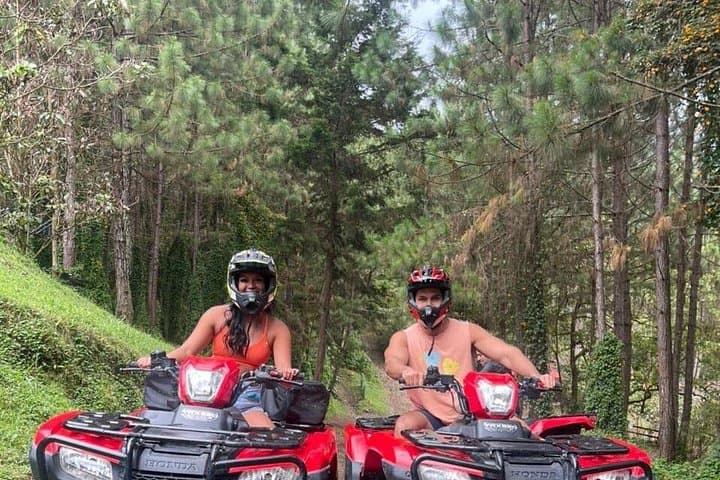
What the day feels like
Coming out of Medellín’s green rim, the city shrinks to a square of rooftops and traffic noise. Within twenty minutes the air changes—cooler, drier, laced with the smell of eucalyptus and wet earth—and the road narrows to a dirt ribbon that disappears into hills. Two by two, helmets clipped and hands grounded on throttles, riders shoulder into the first corner and the hillside answers: a chorus of tires and a spray of red-brown soil. This isn’t just a joyride; it’s a way to feel the Aburrá Valley’s contours through vibration and speed, to taste the geological story Medellín sits on while the city recedes behind you.
The tour—ninety minutes from briefing to return—threads forest tracks, farm roads, and switchback fire-routes on the upper slopes around Medellín. You’ll pass patches of secondary cloud forest, cross creek beds that dare you to pick the right line, and crest ridgelines that throw the valley’s sweeping amphitheater into sharp relief. At about 1,400–1,800 meters above sea level, the landscape keeps its temperate spring; the views shift fast, from urban edges to coffee plots and smallholdings where wood smoke and livestock punctuate the air.
Medellín’s setting is part of what makes the experience tactile. The city sits in the Aburrá Valley, carved by tectonics and time; the surrounding mountains are a jigsaw of volcanic and sedimentary rock that gives the trails their gravel and gumbo. Historically, these slopes were dotted with haciendas and coffee farms—today many are still worked, but others have been left to secondary forest, creating a patchwork of private land, small farms, and municipal reserves. Riding here is therefore as much a cultural crossover as it is an off-road one: you’ll rumble past women carrying plantains, small corrals of goats, and the occasional finca where dogs watch you pass with sleepy curiosity.
Local guides know the land and the rhythms of weather here. Because Medellín is nicknamed the “City of Eternal Spring,” the climate is forgiving—mornings are mild, afternoons can warm, and rain moves in quickly and unpredictably in the wet months. Operators have adapted: routes are chosen for safety and spectacle, helmets and safety briefings are standard, and groups are kept deliberately small so drivers can manage lines and minimize impacts on single-track that’s fragile in a tropical mountain environment.
Why book this over a city tour or a coffee finca visit? The ATV tour compresses immediacy and variety. In an hour-and-a-half you go from urban edge to ridgeline view, get a technical run on loam and rock, and a low-key cultural snapshot as you move among working lands. It’s a high-adrenaline flavor of Antioquia that’s accessible—no weeks of trekking needed—but it’s not mindless. The steep sections demand throttle control; the creek crossings ask for route choice; the descents reward composure.
Practicalities: the tour is 90 minutes in length, with roughly 20–30 km of trail covered depending on routing and conditions, and an approximate elevation range of 200–400 meters of change across the ride. Expect moderate physical demand: you’ll be standing on pegs and leaning through turns, so core and back strength help. Operators provide helmets and a short skills session; previous ATV experience is useful but not necessary—guides tailor expectations to skill levels. Safety-wise, keep throttle smooth, follow the guide, and don’t be afraid to ask for a slower line on technical sections.
Timing matters. Morning departures mean firmer tracks and clearer views; afternoons can bring dramatic light but also the possibility of rain. The dry months (December–February, July–August) produce the cleanest routes; wet months mean mud, which is fun if you’re prepared but can reduce visibility and traction.
Beyond the throttle, this is an opportunity to connect with local stories. Drivers and guides are often Antioqueños with farming roots; conversations typically touch on coffee cycles, land-use change, and the ways Medellín’s urban growth has redefined nearby landscapes. It’s a quick lesson in how recreation, rural life, and conservation intersect here.
If you go: wear closed, sturdy footwear; bring sunscreen and insect repellent; hydrate before you start. Respect private land, avoid skidding through fragile single-track, and follow your guide’s line choices to reduce erosion. Operators generally promote responsible riding and some contribute to local reforestation or trail maintenance—ask about these programs when you book.
For travelers who want a shot of speed without long logistics, the Medellín ATV tour is a compact, sensory-rich adventure. It mixes the practical—short transfer times from the city, clear safety protocols, and an instant adrenaline hit—with the intangible: valley views that flatten your perspective of the city below and a tangible sense of place delivered through dust, throttle response, and a guide’s local stories. It’s not the only way to meet Antioquia, but it is one of the most visceral.
Book it for an afternoon when you want to balance city culture with outdoor motion. Go with a mindset of curiosity rather than conquest; there’s more to be gained from thoughtful lines and conversations with guides than from pushing the limits. Walk away with a few images—the valley below like a green scroll, a sun-scarred dirt face of a corner, the smell of damp earth—and the knowledge that Medellín’s mountains are best read at speed and in slow conversation afterward over a cold beer and a plate of bandeja paisa.
Trail wisdom
Small choices, better day.
Book morning slots
Mornings offer firmer trails and clearer views; afternoon showers can make routes slick.
Wear closed, sturdy shoes
Ankle-supporting boots or hiking shoes protect your feet and give better control on pegs.
Hydrate before riding
Riding raises heart rate quickly—drink water beforehand and bring a small bottle for after.
Trust your guide’s lines
Guides pick routes to protect fragile soils and keep groups safe—follow their instructions.
Local knowledge
Read the place, not just the route.
Watch for native species including Toucans (occasionally), Agoutis and small Andean mammals.
Keep an eye out for wildlife during the transition between areas and habitats. Respect distance guidelines.
Stick to designated routes to limit soil erosion; many local operators support trail maintenance or reforestation projects—ask how your booking contributes.
Follow the guide's instructions on size limits, ethical handling, and leave-no-trace practices.
Small roadside coffee stands on the approach road—try a tinto (strong black coffee). A short detour viewpoint where the Aburrá Valley opens like a green amphitheater
Locally recommended viewpoints and quiet spots known best to local operators.
The Aburrá Valley has long been an agricultural corridor for Antioquia; many trails follow old hacienda access roads and coffee farm tracks.
Maritime roots and regional tradition shape the waterways and working coasts.
Seasonal guide
Four versions of the same landscape.
Spring
Best forStable weather · Clear valley views · Beginner-friendly riding
ChallengesOccasional afternoon showers · Dust on long dry spells
Spring months (local dry windows) typically provide firm trails and good visibility—ideal for first-timers.
Summer
Best forLush green landscapes · Photogenic light · Technical mud riding
ChallengesHeavier rains possible · Slippery creek crossings
Summer brings verdant tracks and dramatic skies; be prepared for wet sections and softer ground.
Fall
Best forLess crowded trails · Cooler temperatures · Evening light for photos
ChallengesIntermittent rains · Shorter daylight hours
Fall is pleasant for riders seeking cooler conditions and long shadows for photographs.
Winter
Best forClear vistas on dry spells · Less haze · Good for advanced mud skills
ChallengesRegular rain patterns · Trail closures in extreme weather
Winter months see more rain; when dry, the views are crisp, but operators may reroute for safety.
Operator details
What the booking data adds.
Included
- ✓Equipment such as boots, protections and raincoats
- ✓Guide (Spanish and English)
Not included
- —Tips
Good to know
- ✓Public transportation options are available nearby
- ✓Not recommended for travelers with spinal injuries
- ✓Not recommended for pregnant travelers
- ✓Suitable for all physical fitness levels
Pack with intention
What to bring.
Good to know
Common questions.
No—operators provide a short orientation and tailor the route to skill levels, though basic comfort with throttle and brakes helps.
Plan the edges
The details that make the day easier.
Medellín is nicknamed the 'City of Eternal Spring' because of its temperate climate—average annual temperatures hover around 22°C (72°F).
After the ride, head back to Laureles or El Poblado for a cold local beer and a plate of bandeja paisa or grilled meats; try a specialty coffee in a neighborhood café to taste Antioquia’s beans—many small roasters in Medellín source from nearby farms.
- Closest airport
- José María Córdova (MDE) ~35 km; Typical drive from central Medellín: 20–30 minutes; Cell service: good near trailheads, spotty on remote ridges; Permits: none typically required; operator confirmation: INSTANT; Cancellation: free cancellation available.
Stay on established trails to reduce erosion; support operators who invest in trail maintenance and local community projects; avoid idling vehicles near farmhouses to minimize disturbance.
Explore by topic
Follow the threads.
Keep exploring
Make the story part of the trip.
 Related story
Less than two hours from Nairobi, Kereita Forest pairs hands-on canopy adventure with quiet montane trails and a sobering colonial history—perfect for families, teams, and curious travelers seeking a full-day pulse of nature.
Set out from Bass Harbor for a private, customizable day on Blue Hill Bay — lighthouses, puffins, seals, and the chance to feel Acadia from the water. Small groups, local captains, unforgettable views.
In four hours you can move from shaded canyon ferns to wind-scoured coastal ridgelines, guided by someone who knows where the light—and the hidden views—live. This private half-day hike on the Monterey Peninsula or Big Sur is compact, curated, and perfect for travelers who want depth without a multiday commitment.