
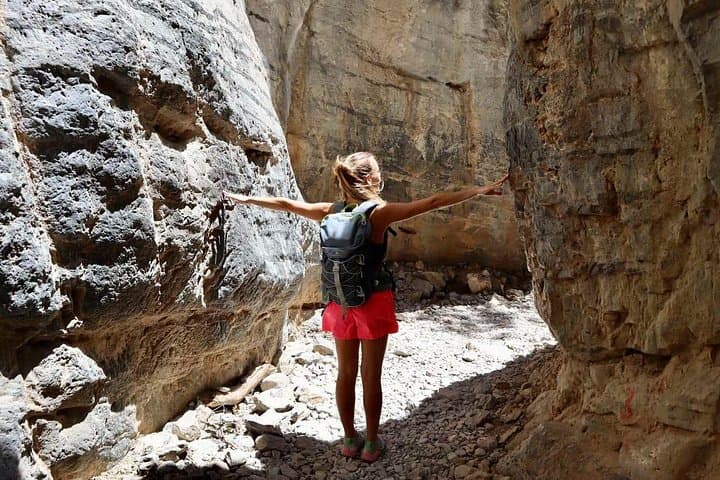
What the day feels like
The path narrows and the light goes thin. Rock walls fold over you like pages—banded limestone streaked with ochre and gray—while a cool draft moves up from the canyon floor as if the land itself is breathing. Underfoot, the trail alternates between packed earth and bronze-glittered scree; above, almond and olive trees cling to terraces carved by centuries of shepherds. You walk in single file and, if you pause, you can hear the sea: a faraway, steady punctuation that promises a different kind of salt and heat at the end of the descent.
That is Imbros Gorge: a short, decisive canyon on Crete’s southern flank that rewards precise effort with open ocean. Unlike its more famous neighbor Samaria, Imbros feels private. The walls are lower, the steps fewer, and in the slack hours of summer the trail offers a rare luxury—room to be alone with the geology and the island’s long human story. For most travelers a guided, private hike is the clearest way to thread the gorge and then slip into the quieter shoreline of Frangokastelo for a cooling swim and a family-style taverna meal.
Geologically, Imbros tells a chapter of the island’s tectonic history. The gorge is carved into Cretaceous limestone and dolomite; the folded layers you pass represent epochs of ocean floor thrust upward by the African and Eurasian plates. That same uplift created the steep southern coast where the Libyan Sea sprawls beneath cliffs and pocket beaches. Culturally the trail is threaded with memory: local guides point out the wartime tracks used by Allied soldiers during World War II and the shepherd routes that shaped the terraces and water cisterns along the way.
A private guided hike—bookable as a single-day experience that combines the gorge walk with a swim at Frangokastelo and a meal at a family-run taverna—lets you move deliberately. The itinerary usually begins with a morning pick-up near Chania or a nearby village, a short drive across olive-scattered hills, then a descent that takes 2–3 hours on the trail itself. Expect roughly 8 kilometers (about 5 miles) of route with 300–400 meters of elevation change, largely downhill, across rocky and uneven terrain. The payoff is literal: emerging near the shore to wade into clear, calm water and later drying off over grilled fish and fresh lemon-dressed greens while the fortress silhouette of Frangokastelo keeps watch.
Why go guided? The private guide provides context—botany, geology, and stories about local life—that turns a walk into an education. They manage logistics so you’re not juggling car drops or uncertain trailheads, and they time the hike to avoid crowds and the midday heat. If you want to learn more or reserve a private hike that includes the post-hike swim and taverna meal, consider booking a guided excursion like this Imbros Gorge private guided hike and Frangokastelo swim full-day Crete adventure that bundles transport, local insight, and a quieter beach finish.
Practical edge: footwear matters more here than a light day-sandal. Sturdy hiking shoes with good tread and a low-profile ankle give confidence on shale and steps. Bring sun protection and at least 1–1.5 liters of water per person; the gorge has limited shade in sections and the sun intensifies along spoil-swept terraces. Pack a swimsuit and a quick-dry towel for the Frangokastelo stop—there’s little that feels better after a canyon walk than a sea dip on cool stones.
Timing is straightforward. Spring and fall bring the best temperatures for hiking; summer can be hot but the route’s southern exposure and shorter length still make it doable if you start early. A private tour often schedules a mid-morning start, finishes with a seaside lunch, and returns you to your base by late afternoon—about 3.5 to 4 hours on the ground plus transport (this experience typically lists 220 minutes total activity time).
Local food is part of the point. Family tavernas around Frangokastelo specialize in simple Cretan fare: grilled fish, dakos (rusk with tomato and cheese), slow-roasted lamb, and raki poured by hand. These meals are as informative as the walk, a chance to sample the island’s olive oil, fresh herbs, and the social rhythm of a coastal village.
For photographers the gorge is a study in texture and scale: a wide-angle lens captures the full canyon while a telephoto isolates banded strata and terraces. Bring polarized filters for saturated sea blues at Frangokastelo and low ISO for the shaded canyon sections.
If you have only one day on Crete and want the satisfaction of a true hike without a marathon commitment, the Imbros Gorge private guided hike with a Frangokastelo swim is an elegant, efficient adventure. It marries moving through landscape with a restorative seaside finish and a meal that ties the whole day back into local life—an experience that’s both sensory and instructive. Book a private guided version of this itinerary for a smoother route-finding experience and a richer conversation about the island you’re walking through: Imbros Gorge private guided hike and Frangokastelo swim full-day Crete adventure.
Trail wisdom
Small choices, better day.
Start early
Begin the hike in the morning to avoid heat and to experience the canyon in cooler, quieter light.
Footwear first
Wear sturdy hiking shoes with good grip—sections are rocky and can be slippery after rain.
Bring cash for the taverna
Small family tavernas may accept cash only for lunch and refreshments.
Pack a swimsuit and towel
You’ll want to swim at Frangokastelo—bring a quick-dry towel and a change of clothes.
Local knowledge
Read the place, not just the route.
Watch for native species including Common kestrel, Mediterranean tortoise (in season).
Keep an eye out for wildlife during the transition between areas and habitats. Respect distance guidelines.
Stick to established trails, avoid taking plants or rocks, and support local tavernas and guides who use sustainable practices.
Follow the guide's instructions on size limits, ethical handling, and leave-no-trace practices.
A quiet sundrenched terrace near the gorge exit where locals hang laundry and chat. The Venetian fortress at Frangokastelo—visit early morning for empty light and the 'Drosoulites' story
Locally recommended viewpoints and quiet spots known best to local operators.
Imbros’ mule paths were used by Allied forces in WWII; Frangokastelo’s castle dates to the Venetian era and has local ghost-legend lore.
Maritime roots and regional tradition shape the waterways and working coasts.
Seasonal guide
Four versions of the same landscape.
Spring
Best forcooler hiking temperatures · wildflowers and birding · quieter trails
Challengesoccasional rain · some muddy sections
Spring offers mild weather and blooming terraces—ideal for comfortable hiking and photography.
Summer
Best forsea swimming · long daylight · taverna dining
Challengeshigh temperatures midday · bigger tourist numbers
Summer is perfect for the beach finish but plan for early starts and sun protection on the trail.
Fall
Best forpleasant hiking temps · fewer crowds · harvest-season food
Challengesshorter daylight · cooler water temperatures
Autumn balances comfortable hiking with excellent local produce at tavernas.
Winter
Best fordramatic skies and solitude · lower prices · green terraces
Challengesrainy periods · possible trail closures
Winter can be atmospheric and quiet but expect wet conditions and check local guidance before heading out.
Operator details
What the booking data adds.
Included
- ✓Lunch
- ✓Experienced Guide
- ✓Walking sticks
Not included
- —entrance fee 3 euros per person
Good to know
- ✓Not recommended for travelers with spinal injuries
- ✓Not recommended for pregnant travelers
- ✓Not recommended for travelers with poor cardiovascular health
- ✓Suitable for all physical fitness levels
Pack with intention
What to bring.
Good to know
Common questions.
The route covered by most guided itineraries is about 8 kilometers (roughly 5 miles) and takes 2–3 hours on the trail depending on pace and stops.
Plan the edges
The details that make the day easier.
The Venetian fortress at Frangokastelo dates to the 14th century and the area is associated with the famed 'Drosoulites'—a recurring optical phenomenon locals link to battle-era shadows.
After the hike, head to a family-run taverna in Frangokastelo for grilled fish, dakos, and house raki; locals will often recommend off-menu seasonal dishes—ask what’s just come in from the sea.
- Closest airport
- Chania (CHQ). Driving from Chania: ~1–1.5 hours to trailhead depending on meeting point. Cell service: intermittent in the gorge. Permits: none required for day visits. Tour Type: Private guided hike with swim and taverna lunch.
Respect local paths and coastal habitats; pack out any trash, avoid single-use plastics, and choose local guides and tavernas that source ingredients sustainably.
Explore by topic
Follow the threads.
Keep exploring
Make the story part of the trip.
 Related story
Less than two hours from Nairobi, Kereita Forest pairs hands-on canopy adventure with quiet montane trails and a sobering colonial history—perfect for families, teams, and curious travelers seeking a full-day pulse of nature.
Set out from Bass Harbor for a private, customizable day on Blue Hill Bay — lighthouses, puffins, seals, and the chance to feel Acadia from the water. Small groups, local captains, unforgettable views.
In four hours you can move from shaded canyon ferns to wind-scoured coastal ridgelines, guided by someone who knows where the light—and the hidden views—live. This private half-day hike on the Monterey Peninsula or Big Sur is compact, curated, and perfect for travelers who want depth without a multiday commitment.