
What the day feels like
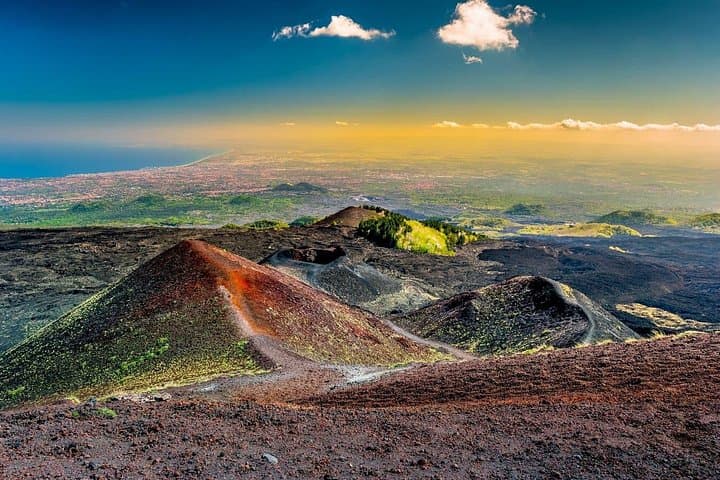
The air on Etna at dawn is thin and honest—cold enough to sharpen the senses, wide enough to make the world feel like it belongs to you for a few hours. We start low, where olive groves and vineyards hold a fragile green against the black scars of old lava. By the time the road winds up past the Rifugio Sapienza and the trees thin into scrub, the island has traded its soft edges for raw geology: hummocks of pumice, sheets of pahoehoe, and the rounded silhouettes of older craters. The day is a study in contrasts—scorched summit panoramas and, later, a narrow river canyon carved into basalt columns that looks almost intentionally theatrical.
This is the kind of route that teaches you how a landscape remembers. Mount Etna, Europe’s most active volcano, has been writing and rewriting its story for hundreds of thousands of years. Each eruption lays down a new chapter—lava streams that harden into ridges, ash that feeds vineyards only a decade later. The Alcantara Gorges, carved by a river working through a recent lava flow, are the bookend: instead of fire building the scenery, water patiently cuts it. Walking from one to the other across a single day gives you both sides of that geological conversation.
Local guides will point out the small things that mapmakers miss: scoria the color of old coins, lichens that colonize fresh rock like paint drying, and the way certain stone terraces hum with heat days after a fissure. You’ll get to a viewpoint at roughly 2,000 meters where Etna opens like a raw wound and the Tyrrhenian Sea glows in the distance. Then you descend into the Alcantara Gorges—towering basalt flutes where the river dares you to keep your balance on slick stones and invites you, on warmer days, to dangle toes in the current.
The experience balances heavy geology with human-scale pleasures. In mountain towns like Zafferana and Randazzo, winsome cafes still serve granita and thick coffee, and local producers press wine from the volcanic soils labeled Etna DOC. The cultural thread is short: people have adapted to living on the edge of fire. Vineyards planted in ash yield grapes with an unexpectedly mineral backbone; olive trees twist into contorted sculptures that whisper of resilience.
Practical details matter here. The tour moves at a deliberate pace—expect a 7–8 hour day that includes driving between sites, a handful of short hikes across uneven volcanic terrain totaling roughly 4–6 kilometers of walking, and some elevation change as you climb to viewpoints around 1,800–2,000 meters. Footwear with good grip is non-negotiable; trekking poles are smart on the loose scree sections. Most operators drive participants to higher elevations, limiting strenuous ascent, but the trails are rocky and may require short, steep efforts.
Weather is volcanic in temperament too: bright and wind-swept at altitude, humid and cool in the gorges. Weekdays and shoulder seasons offer quieter trails. Because Etna is active, operators emphasize flexibility—routes can adjust if fumaroles or fresh flows close a path. Guided walks not only reduce logistical friction but enrich the day: a naturalist explaining how lava columns form, a local telling the story of an eruption that reshaped a town. If you want a reliable, well-paced day that pairs summit panoramas with the intimate drama of a river-cut canyon, this is a rare double bill.
Safety and sustainability go hand in hand. Stay on marked trails so fragile pioneer plants can recover, don’t collect volcanic rock as souvenirs, and pack layers—temperatures can swing 10–15 degrees between the ridge and the gorge. Photographers should plan for wide-angle vistas at the crater and intimate, vertical-frame shots in the gorge where basalt columns create natural leading lines.
For travelers, the payoff is visible and visceral: walks that make you aware of time in geological increments, a canyon that seems hand-carved, and the odd comfort of eating an arancino in a town built on fresh lava. For planning and booking, local expert-run tours streamline transfers and provide context you won’t get from a map. If you’d like a guided option that links the highs of volcanic summits with the low, river-hewn drama of basalt canyons, see this detailed day tour that stitches both experiences together: <a href='https://app.advcollective.com/local-experts/etna-and-alcantara-gorges-volcano-highs-and-lava-cut-canyons-day-tour'>Etna and Alcantara Gorges</a>.
Walk prepared and with curiosity, and the day will reward you with geology, culture, and the strange pleasure of standing where the earth once chose to be undone and then made whole again.
Trail wisdom
Small choices, better day.
Footwear First
Wear sturdy hiking boots with sticky soles—volcanic scree and basalt can be slippery and unforgiving.
Layer for Altitude
Temperatures can drop on the summit—pack a light insulated layer and wind shell even on warm days.
Hydration & Snacks
Bring at least 1.5 liters of water and high-energy snacks; guided days can stretch 7–8 hours with limited services.
Respect the River
Stones in the Alcantara Gorges are slick—use caution near the water and avoid climbing on basalt columns.
Local knowledge
Read the place, not just the route.
Watch for native species including Sicilian kestrel, Sicilian mouflon (wild sheep).
Keep an eye out for wildlife during the transition between areas and habitats. Respect distance guidelines.
Stay on marked trails, don’t remove volcanic rock or plants, and support local guides who contribute to conservation and economic resilience.
Follow the guide's instructions on size limits, ethical handling, and leave-no-trace practices.
Zafferana Etnea village for local honey and pastries. A short viewpoint near Castiglione di Sicilia for sweeping views of both Etna and the Alcantara valley
Locally recommended viewpoints and quiet spots known best to local operators.
Etna’s eruptions have shaped human settlement patterns for millennia; local towns rebuilt repeatedly and developed unique agricultural practices adapted to volcanic soils.
Maritime roots and regional tradition shape the waterways and working coasts.
Seasonal guide
Four versions of the same landscape.
Spring
Best forWildflowers · Moderate temperatures · Clear summit views
ChallengesUnpredictable weather · Late snow at higher elevations
Spring offers mild temperatures and blooming mountain flora; bring layers for cool mornings and possible wind.
Summer
Best forStable weather · Long daylight · River paddling at the gorge
ChallengesHeat at low elevations · Crowds in July/August
Summer delivers reliable weather but expect hotter coastal sections and busier sites; early starts beat the heat.
Fall
Best forCrisp air and colors · Harvest festivals · Quieter trails
ChallengesShortening daylight · Occasional rain
Autumn is prime for clearer air and fewer crowds—perfect for photography and wine-focused side trips.
Winter
Best forSnowy crater views · Dramatic contrasts · Fewer tourists
ChallengesSnow and ice on trails · Road or access closures due to eruptions
Winter can be spectacular but unpredictable; guided tours adjust routes for safety when snow or activity restrict access.
Operator details
What the booking data adds.
Included
- ✓Professional guide
- ✓walking stick
- ✓Air-conditioned vehicle
- ✓ticket for the Alcantara gorges
Not included
- —Lunch
Good to know
- ✓Infants and small children can ride in a pram or stroller
- ✓Public transportation options are available nearby
- ✓Specialized infant seats are available
- ✓Not recommended for travelers with spinal injuries
- ✓Not recommended for pregnant travelers
- ✓Not recommended for travelers with poor cardiovascular health
- ✓Suitable for all physical fitness levels
Pack with intention
What to bring.
Good to know
Common questions.
Expect a 7–8 hour day with roughly 4–6 km of walking across varied terrain—short steep sections and rocky surfaces are common.
Plan the edges
The details that make the day easier.
Mount Etna is the highest active volcano in Europe, reaching roughly 3,329 meters (height varies with eruptions), and was inscribed as a UNESCO World Heritage Site in 2013.
After the day, head to nearby Zafferana Etnea for honey-infused pastries and strong espresso, or sample Etna DOC wines in a local enoteca; the volcanic soils give reds a distinct mineral lift.
- Closest airport
- Catania Fontanarossa (CTA) ~50–70 km; typical driving time from Catania to mountain parking 1–1.5 hours; cell service is generally good near towns but patchy above 1,800 m; no special permits required for the standard tour route—guided tours handle local access.
Stay on designated paths, pack out all waste, don’t remove rocks or plants, and choose local guides whose fees support conservation and community resilience.
Explore by topic
Follow the threads.
Keep exploring
Make the story part of the trip.
 Related story
Less than two hours from Nairobi, Kereita Forest pairs hands-on canopy adventure with quiet montane trails and a sobering colonial history—perfect for families, teams, and curious travelers seeking a full-day pulse of nature.
Set out from Bass Harbor for a private, customizable day on Blue Hill Bay — lighthouses, puffins, seals, and the chance to feel Acadia from the water. Small groups, local captains, unforgettable views.
In four hours you can move from shaded canyon ferns to wind-scoured coastal ridgelines, guided by someone who knows where the light—and the hidden views—live. This private half-day hike on the Monterey Peninsula or Big Sur is compact, curated, and perfect for travelers who want depth without a multiday commitment.