
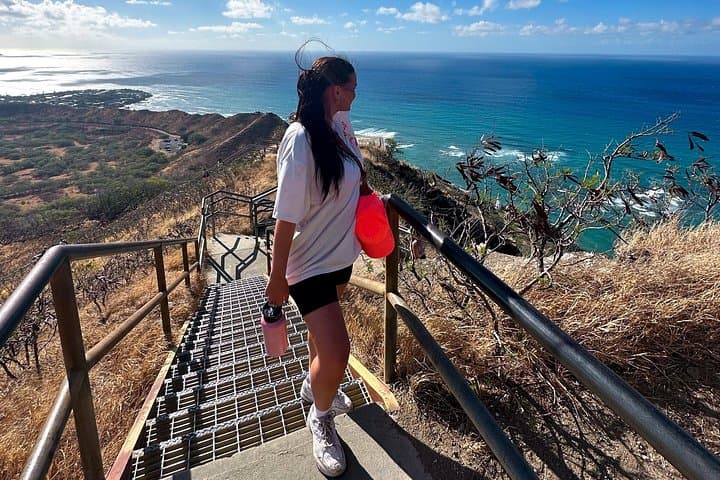
What the day feels like
By the time the van slips away from the thread of Waikiki hotels and dips under the shadow of the volcanic cone, Honolulu has just begun to wake. You stand at the trailhead of Diamond Head — Leahi to Hawaiians — with the Pacific laid out like glass, an early sun polishing the surf of Waikiki into a long ribbon of light. The climb ahead is short and steep: concrete steps, a switchback, a tunneled stairway that has carried soldiers and sightseers for a century. But the crater keeps its own rules. It nudges, tests, and rewards. At the rim the view opens suddenly and simply. You feel the island at once: the city, the reef-edged sea, the long sweep of the south shore, and the ragged shoulder of Koko Crater far to the southeast.
The itinerary that packs this morning into a single private tour is an appealing one because of its contrasts. Diamond Head is breezy, exposed, and geologic — a volcanic tuff cone born out of Honolulu's violent, volcanic youth. Manoa Falls, by contrast, is soft, cloaked, and green: a rainforest-wet valley that drinks the clouds, where bamboo thickets clap in the wind and the path narrows into something more intimate. Both walks are short in distance yet generous in character, and stitched together they give a tidy primer on Oahu’s extremes.
Diamond Head itself is a geological postcard. The crater formed roughly 300,000 to 400,000 years ago during the Honolulu Volcanic Series when magma blasted through older lava flows, building a tuff cone that later collapsed into the bowl hikers now explore. The rim became strategically important in the early 20th century: military bunkers and observation posts were installed to keep watch over the harbor below. Today, the trail weaves through those relics. The same staircases worn by soldiers now serve families, photographers, and anyone who wants a rapid and panoramic survey of Honolulu.
Manoa Valley sits five miles inland, a world away. Polynesian voyagers and later Hawaiian farmers used valley floors like Manoa for growing taro and other staples. Today the trail to Manoa Falls threads past the University of Hawaii and into a humid, living museum — with species brought from around the Pacific alongside native plants. Bamboo corridors give way to ferny understory and a final short scramble to the 150-foot waterfall. The pool at the waterfall is tempting, its water catching sunlight under a canopy of leaves, but local health advisories sometimes close swimming because of bacterial concerns, so respect posted signs and use judgment.
This tour is private and customizable, which is the real luxury in a place as popular as Oahu. The morning fits an audio guide for the Diamond Head climb, a to-go breakfast stop where you can sample a malasada or acai bowl, then a guided roll into Manoa with time to listen and look. Guides can extend the day to include over 30 more points of interest around the island, from scenic overlooks to cultural stops. For first-time visitors or those pressed for time, the combination is tightly efficient: you get a taste of the coast and the interior without the pressure of planning transit or parking.
Practicalities matter when you are hiking in two climates in a single day. Diamond Head’s exposed trail is hot and reflective; start early, slip on sunscreen, and bring sunglasses. Manoa is forgivingly shaded but can be muddy, so traction matters. The two hikes combined are moderate in effort: the Diamond Head round trip is about 90 minutes on a well-graded trail with stairs, while Manoa Falls is roughly a 60-minute round trip through softer, wetter terrain. The tour's total time runs about six to seven hours, which includes transfers, a breakfast stop, and the option to linger at viewpoints.
Safety and stewardhip are straightforward: stay on the trails to protect fragile native plants, avoid swimming at Manoa Falls when signs are posted, and pack out any trash. Because the tour is private, it’s easier to move at your own pace and ask questions about the island’s ecology and history — a value for curious travelers who want context and conversation.
When to go? Mornings are best to beat both crowds and heat. The dry season from April through October offers more predictable weather for the Diamond Head climb, but Manoa’s allure is year-round; the valley thrives on rain. Regardless of timing, aim to arrive before 9 a.m. at Diamond Head to secure parking and to enjoy softer light for photography.
For photographers, Diamond Head gives wide-angle opportunities: rim panoramas, layered coastline, and the striated geometry of the crater walls. Manoa rewards detail work — moss, drip-lines, and the scale of bamboo against the waterfall. A polarizing filter can deepen greens and cut glare, while a small tripod or stabilizer helps with low-light forest scenes.
If you want more than two walks, the private tour can pivot: stop by the Lyon Arboretum for a plant-focused detour, loop through Tantalus Drive for a sunset view, or explore Waikiki’s food scene after the hike. At about $149 per person from the listing, the tour offers value for a private experience that simplifies logistics and maximizes time on the trail.
In a single morning you can feel the island's two faces: the volcanic backbone that shaped the coast and the deep, wet valleys that taught Hawaiians how to live here. Both are immediate and accessible, and each rewards the same basic curiosity — get out the door early, look up and listen, and let the island lead the way.
Trail wisdom
Small choices, better day.
Start early
Begin at first light to avoid crowds and midday heat at Diamond Head and to enjoy softer light in Manoa Valley.
Footwear matters
Wear shoes with good traction — Diamond Head has concrete steps; Manoa can be muddy and slippery after rains.
Respect posted signs
Swimming at Manoa Falls is sometimes prohibited for health reasons; follow closures and stay on trails to protect native plants.
Hydrate and snack
Pack at least 1–2 liters of water and energy snacks, especially for the exposed climb at Diamond Head.
Local knowledge
Read the place, not just the route.
Watch for native species including Wild chickens commonly roam residential and roadside areas, Native honeycreepers such as the ʻapapane and other forest birds in higher ridges.
Keep an eye out for wildlife during the transition between areas and habitats. Respect distance guidelines.
Stay on marked trails, pack out waste, and avoid disturbing native plants; check advisories before swimming at waterfall pools due to water-borne bacteria.
Follow the guide's instructions on size limits, ethical handling, and leave-no-trace practices.
Lyon Arboretum — a quiet botanical garden and research site near Manoa with microtrails. Tantalus / Puu Ualakaa Drive — a short detour for a sunset overlook above Honolulu
Locally recommended viewpoints and quiet spots known best to local operators.
Diamond Head (Leahi) was used as a coastal defense lookout and has military bunkers from the early 20th century; Manoa Valley historically supported Hawaiian taro cultivation and remains culturally significant.
Maritime roots and regional tradition shape the waterways and working coasts.
Seasonal guide
Four versions of the same landscape.
Spring
Best forCooler mornings · Fewer crowds · Wildflower growth
ChallengesVariable showers · Sticky trails in Manoa
Spring brings mild weather and fewer tourists; trails are pleasant but expect occasional rain in the valley.
Summer
Best forDry weather · Predictable ocean views · Long daylight
ChallengesHeat and humidity · Peak visitor crowds
Summer offers clear vantage points from Diamond Head but plan for early starts to beat the heat and crowds.
Fall
Best forStable weather · Good lighting · Lower visitor numbers
ChallengesOccasional storms · Sticky humidity in valley
Fall is a strong shoulder season with warm, stable days and excellent late-afternoon light for photos.
Winter
Best forLush rainforest at Manoa · Storm-swollen waterfalls · Whale watching offshore from vantage points
ChallengesHigher rainfall in valleys · Mud and slick conditions · Rough seas sometimes
Winters are wetter; Manoa is vivid and dramatic but wear waterproof layers and expect muddy trails.
Operator details
What the booking data adds.
Included
- ✓Hotel pickup and drop-off
- ✓Professional guide
- ✓Diamond Head Audio Guide
- ✓All Fees and Taxes
- ✓Live commentary on board
Not included
- —Gratuity
- —We can stop at a local breakfast spot
Good to know
- ✓Specialized infant seats are available
- ✓Suitable for all physical fitness levels
- ✓Children must be accompanied by an adult
- ✓Please bring towels and sunscreen & extra water
- ✓Please wear comfortable shoes and dress weather appropriate for the hikes (Sneakers or Hiking Shoes)
Pack with intention
What to bring.
Good to know
Common questions.
Diamond Head is about a 90-minute round trip for most visitors; Manoa Falls is roughly a 60-minute round trip depending on pace and stops.
Plan the edges
The details that make the day easier.
Diamond Head, known in Hawaiian as Leahi, is a tuff cone formed roughly 300,000–400,000 years ago during the Honolulu Volcanic Series.
Start with breakfast to-go—try a malasada from Leonard's Bakery or an acai bowl from a Waikiki cafe—then unwind after the tour with local favorites: lunch at Rainbow Drive-In for plate lunch classics or a creative meal at The Pig & The Lady in Honolulu. For a quiet cultural stop, walk the trails at Lyon Arboretum adjacent to Manoa.
- Closest airport
- Daniel K. Inouye International Airport (HNL)
- Diamond Head trailhead
- ~3 miles from central Waikiki (10–20 minutes drive)
- Manoa Falls trailhead
- ~6 miles from Waikiki (15–30 minutes)
- Cell service
- Good in Waikiki and at Diamond Head rim; spotty in Manoa Valley
- passes
- Diamond Head State Monument charges entrance and parking fees — check Hawaii State Parks for current rules.
This route visits state parks and sensitive rainforest habitat—stay on marked trails, pack out all trash, avoid swimming where posted closed, and support local businesses to keep tourism sustainable.
Explore by topic
Follow the threads.
Keep exploring
Make the story part of the trip.
 Related story
Less than two hours from Nairobi, Kereita Forest pairs hands-on canopy adventure with quiet montane trails and a sobering colonial history—perfect for families, teams, and curious travelers seeking a full-day pulse of nature.
Set out from Bass Harbor for a private, customizable day on Blue Hill Bay — lighthouses, puffins, seals, and the chance to feel Acadia from the water. Small groups, local captains, unforgettable views.
In four hours you can move from shaded canyon ferns to wind-scoured coastal ridgelines, guided by someone who knows where the light—and the hidden views—live. This private half-day hike on the Monterey Peninsula or Big Sur is compact, curated, and perfect for travelers who want depth without a multiday commitment.