
What the day feels like
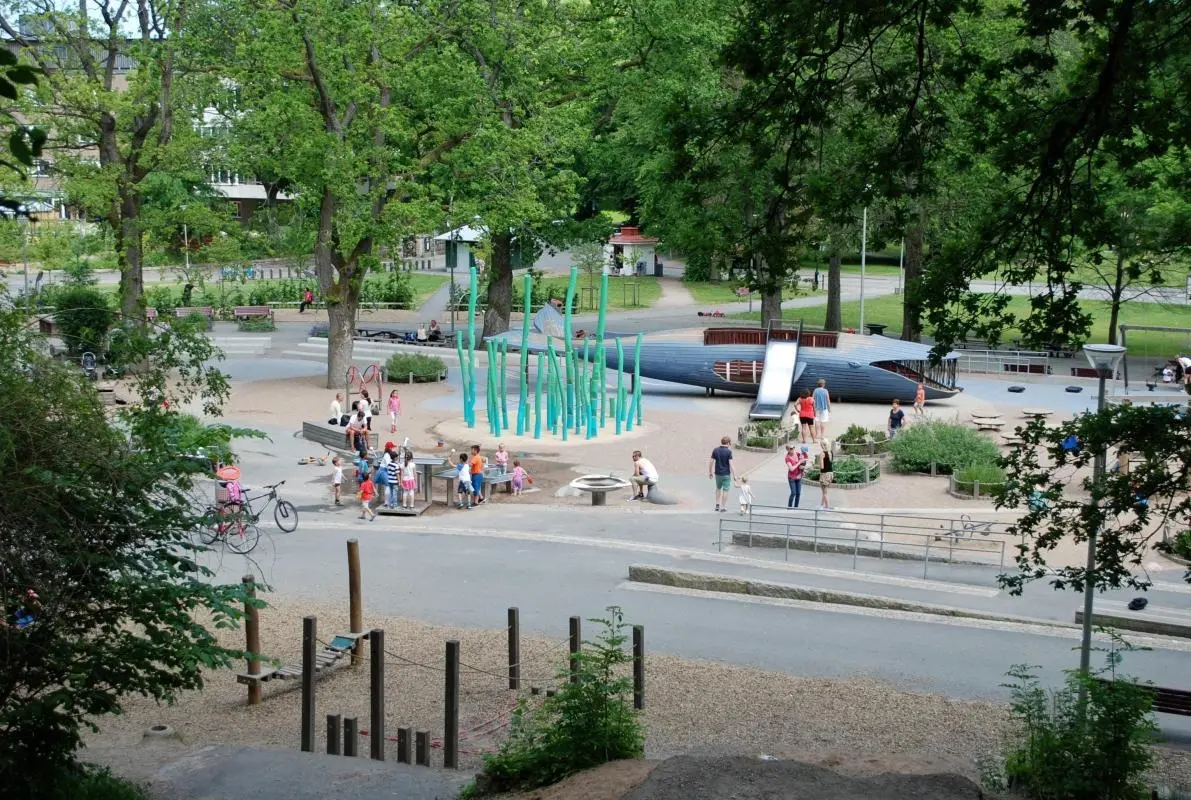
You step off the tram and the city’s glass and granite give way to a pocket of trees whose trunks lean in as if to whisper directions. A gust pulls a chorus of leaves; a child’s laughter threads through it. This is Slottsskogen Park—Gothenburg’s 137-hectare green lung—where locals picnic beneath birch canopies, joggers pick a rhythm on gravel loops, and a small, free zoo keeps seals and farm animals in plain sight, uncomplicated and curious.
Begin in the north near the Museum of Natural History, where a mounted blue whale in the museum’s halls is only the largest of the neighborhood’s curiosities. Cross a wooden bridge and you’re inside Slottsskogen proper: open meadows that collect the afternoon sun, winding forest paths that refuse to hurry you, and a low ridge that nudges you into views of the city skyline through the trees. It’s easy to treat this as a gentle outing, but Slottsskogen rewards attention—look closely and you’ll find warblers in the alder stands, an urban fox trail at dusk, and hidden benches carved into hummocks ideal for a long fika.
History is stitched into the soil. Its name literally means "the castle woods," a reference to the royal hunting grounds that predated the public park. In the late 19th century Slottsskogen was reshaped into municipal greenspace as Gothenburg urbanized, an intentional move to give the cityroom to breathe. Since then it has become the theatrical backdrop to community life: weekend football matches, children’s play in the maze of wooden toys, and the annual Way Out West music festival that turns the park into a temporary city of stages and campers.
Geologically there’s little drama—this isn’t a mountain range—but that’s the point. The park’s gently rolling topography was carved by glacial action and centuries of cultivation; the soil supports an odd mix of planted exotics and robust Scandinavian birch, making for varied light and layers. Botanists and weekend wanderers alike appreciate that the nearby Gothenburg Botanical Garden, included in some private walking tours that start or finish in Slottsskogen, expands the palette from native stands to formal beds and glasshouses—an easy pairing for families or curious travelers.
Culture here is civic and casual. Slottsskogen is where Gothenburgers take their leisure seriously: an unflashy crowd with a practical taste for good coffee and flat-pack picnics. If you’re traveling with kids, the private family walking tour listed through local operators is smart—guides know how to string together the Botanical Garden, the animal enclosures in Slottsskogen, and the Museum of Natural History without turning the day into an exhausted blur. For travelers with more time, the five-day Gothenburg holiday package uses the park as a chapter in a broader narrative—bike rides, boat tours, and old-town strolls—all of which show how Slottsskogen functions as the city’s natural centerpiece.
Practical on-the-ground guidance: the park is flat to gently rolling, with an easy 3–4 km main loop that passes playgrounds, ponds and lawned commons. Elevation change is minimal—think urban hill, not climb—and underfoot is a mix of compacted gravel, turf and flagstone paths. Allow 2–3 hours for a relaxed circuit with stops; half a day if you pair it with the Botanical Garden and Museum. Wear layers—Gothenburg weather shifts quickly—and bring a lightweight rain shell even in summer. The park is public and free to enter; the animal enclosures likewise have no admission charge.
Timing matters. Early morning is when the park is most serene—dew on the grass, dog walkers in steady files, and the light through birch leaves soft and green. Late afternoon offers long shadows and a chance to catch seals at the zoo becoming active. Weekends can be busy, especially in summer during festivals, so midweek visits feel more local.
Safety and courtesy are straightforward: keep dogs leashed in fenced areas, respect the animal enclosures (don’t feed the animals), and stick to paths to protect sensitive meadowland. Public transportation from central Gothenburg is short—trams and buses reach the park in 10–20 minutes—making it an easy stop even on a tight itinerary.
Why go? Slottsskogen isn’t a dramatic trek or an alpine summit; it’s a deliberately human-scaled wild place where culture and nature intersect. For travelers who want an accessible outdoor day with structure—play areas for kids, botanical gardens for the curious, and a small zoo for close encounters—there are few greener, friendlier options inside a European city. It’s a place to walk, linger, and learn how Gothenburg takes leisure seriously: clean, communal, and stubbornly practical.
If you’re compiling an itinerary, combine a guided family walk that includes the Botanical Garden and Museum for a tight, enriching half-day (most private tours last about two hours), or slot Slottsskogen as the afternoon in a longer five-day Gothenburg package that pairs city art, archipelago boat tours, and local food. Either way, bring sturdy shoes, an appetite for slow discovery, and a curiosity about how a city parks its wild heart.
Slottsskogen doesn’t demand heroics. Instead it promises small, honest rewards: a bench where the light is always right for reading, a pond where ducks rearrange their breakfast, and a patch of grass that makes a sudden nap feel worry-free. It’s the sort of place where even seasoned travelers—tired of monuments and checklist tourism—will find something easily remembered and quietly vital.
Trail wisdom
Small choices, better day.
Go early for quiet light
Morning visits offer soft light for photos and fewer crowds—ideal for birdwatching and a calm walk around the main loop.
Bring a lightweight rain shell
Gothenburg weather changes quickly; a packable waterproof keeps you dry without taking up space.
Respect animal enclosures
The small zoo is free to visit but animals are on managed diets—do not feed or lean on fences.
Pair with the Botanical Garden
Combine Slottsskogen with a short visit to Gothenburg Botanical Garden for more diverse plant displays and a longer half-day outing.
Local knowledge
Read the place, not just the route.
Watch for native species including harbour seals in the park enclosures, domestic sheep and goats at the children’s zoo.
Keep an eye out for wildlife during the transition between areas and habitats. Respect distance guidelines.
The park is managed to balance recreation with habitat protection—stick to marked paths and carry out waste to minimize impact.
Follow the guide's instructions on size limits, ethical handling, and leave-no-trace practices.
A small pond on the eastern loop where warblers gather at dawn. A cluster of secret benches on a slight ridge with filtered city skyline views
Locally recommended viewpoints and quiet spots known best to local operators.
Slottsskogen was transformed into a public park in the late 19th century and named for its origins as part of royal hunting grounds; it’s since been a civic focal point for leisure and public events.
Maritime roots and regional tradition shape the waterways and working coasts.
Seasonal guide
Four versions of the same landscape.
Spring
Best forwildflower viewing · birdwatching · family picnics
Challengesmuddy paths after rain · cool mornings
Spring brings fresh greenery and nesting birds; paths can be soft after rains, so wear waterproof shoes.
Summer
Best foroutdoor concerts · long daylight walks · children’s playtime
Challengeslarger crowds · festival closures during events
Summer is peak park life—expect festivals and full lawns, but also long, pleasant evenings.
Fall
Best forleaf color · calmer trails · photography
Challengesshorter daylight · chillier winds
Autumn colors are vivid and crowds thin; pack warm layers for changing temperatures.
Winter
Best forquiet walks · occasional sledding on small hills · dramatic bare-branch photos
Challengescold, possible icy patches · limited animal activity
Winter visits are peaceful but cold; traction on shoes and thermal layers are useful.
Pack with intention
What to bring.
Good to know
Common questions.
Yes—the park and most public areas, including the small animal enclosures, are free to enter.
Plan the edges
The details that make the day easier.
Slottsskogen hosts the annual Way Out West music festival and was designed as a public park in the late 19th century to provide urban green space for Gothenburg residents.
Slottsskogen sits beside the leafy Linnéstaden neighborhood—stop afterward for a fika at a nearby café and sample Gothenburg’s seafood scene at the market halls for a full local day.
- Know-before-you-go
- free entry, 137 hectares, main loop ~3–4 km, tram access 10–20 minutes from central Gothenburg, family-friendly, minimal elevation.
Use public transit to reach the park, carry out all trash, avoid feeding animals, and stay on marked paths to protect meadow flora and nesting birds.
Explore by topic
Follow the threads.
Keep exploring
Make the story part of the trip.
 Related story
Dive into the Yucatán’s secret freshwater caverns and drift over the shallow reef gardens of Yalku Lagoon—an accessible, half-day snorkel pairing that blends geology, Mayan history, and vivid marine life.
 Related story
Slip beneath Porto Santo’s sunlit surface to find a mosaic of seagrass meadows, volcanic shelves, and playful schools of fish. This three-hour snorkeling tour pairs small-group access with local stewardship—ideal for travelers who value marine life over crowds.
 Related story
Spend a day on a high-speed boat exploring Cozumel’s famed reefs and the shallow sand flats of El Cielo. This full-day trip offers clear water, abundant marine life, and guided snorkeling at three prime sites—ideal for both first-timers and seasoned reef lovers.